Patterson – on February 9, 1931 at her son’s residence, Sheet Anchor, Nelly Christina, relict of James and mother of Prince Josephus, Headmaster, Bartica E. School, Harriet Rebecca, Assistant Teacher Sheet Anchor E. School, and Cecil Orpheaus, Headmaster, Sheet Anchor E. School – aged 67 years. Thy will be done
Source: The Daily Chronicle, Georgetown, British Guiana – Wednesday, February 11, 1931: page 4.

What are the maternal and paternal haplogroup of our DNA Sancho ancestors and relatives at home (Africa) and abroad? What are the mitochondrial DNA and Y chromosome of the parents of Bentick Sancho and Tuckness Sancho? Who are Sancho ancestors of Swainton Blaire Christopher, George Sancho, Joshua Sancho, Adelaide Sancho, Eliza Frank, Charles Edward Pilgrim, Jacob Williams, Ann Williams, Isabel Gordon, Agnes Louisa Wood, Amelia Sancho, Mary Sharper, Haile Sancho, Apollo Sancho, Jemmy Sancho
Wednesday, July 19, 2006


Wednesday, June 14, 2006
JACOBS – Kinship of Sancho
JACOBS – Kinship of Sancho – are descendants of three sisters whose maiden name is Jacobs. The sisters married the Harry brothers of Golden Grove and Nabaclis Village District, and Harmon of Ann’s Grove Village.
AGEDA
Clarabell Ageda, wife of Winston Frederick Lawrence, Carpenter, born: January 2, 1915 at Nabaclis, East Coast Demerara, son of Aaron Victor Lawrence, Head Teacher, Goed Fortuin, West Bank, Demerara.
Clarabell Ageda and Winston Frederick Lawrence were married on June 19, 1940. They reproduced a daughter and resided at Nabaclis, East Coast Demerara.
[Source: Roth, Vincent and Delph, Charles Noel (editors) Who is Who in British Guiana, (Fourth Edition, 1945 – 1948: Page 312]
CANTERBURY
Thelma Agatha Lawrence, daughter of schoolmaster, Aaron Victor Lawrence, and his wife, Nora Olive Loncke, and CLARENCE FITZGERALD CANTERBURY, (born: July 9, 1912, Golden Grove, East Coast Demerara, British Guiana) were married on 29 June 1940.
HARMON
ELVIE JACOBS, wife of Harmon, mother of Chris Harmon. This family resided in Ann’s Grove, East Coast Demerara.
HARRY
Rebecca Jacobs, wife of Joseph Harry, mother of Dora Harry.
Jacobs, wife of Edward Harry, Mother of Theodore Harry, Kirby Harry, Daniel Harry and Edward Harry.
LAWRENCE
Jane Jacobs, wife of Henry Lawrence, Sexton, St. Andrew’s Anglican School, Cove and John, East Coast Demerara, and the mother of Aaron Victor Lawrence, Head Teacher, Goed Fortuin, West Bank, Demerara.
This Jacobs-Lawrence family resided at Victoria Village, East Coast Demerara, British Guiana (now Guyana)
[Source: Roth, Vincent and Delph, Charles Noel (editors) Who is Who in British Guiana, Fourth Edition, 1945 – 1948: Page 311]
LONCKE
Nora Olive Loncke, wife of the schoolmaster, Aaron Victor Lawrence, born: March 20, 1892 at Victoria, East Coast Demerara, son of Henry Lawrence, Sexton, St. Andrew’s Anglican School, Cove and John, East Coast Demerara, and his wife, Jane nee Jacobs. Nora Olive Loncke and Aaron Victor Lawrence were Married on December 14, 1916. this union reproduced six sons and four daughters, including, Winston Frederick Lawrence, Thelma Agatha Lawrence, Charlie Lawrence, Niney Lawrence, MacLean Lawrence.
Prior to December 1948, the family were resident at Lot 54 Fifth Street, Georgetown 5.
[Source: Roth, Vincent and Delph, Charles Noel (editors) Who is Who in British Guiana, Fourth Edition, 1945 – 1948: Page311]
Lloyd MacLean Lawrence, child of MacLean Lawrence married Robin.
SMITH
Dora Harry married Smith.
AGEDA
Clarabell Ageda, wife of Winston Frederick Lawrence, Carpenter, born: January 2, 1915 at Nabaclis, East Coast Demerara, son of Aaron Victor Lawrence, Head Teacher, Goed Fortuin, West Bank, Demerara.
Clarabell Ageda and Winston Frederick Lawrence were married on June 19, 1940. They reproduced a daughter and resided at Nabaclis, East Coast Demerara.
[Source: Roth, Vincent and Delph, Charles Noel (editors) Who is Who in British Guiana, (Fourth Edition, 1945 – 1948: Page 312]
CANTERBURY
Thelma Agatha Lawrence, daughter of schoolmaster, Aaron Victor Lawrence, and his wife, Nora Olive Loncke, and CLARENCE FITZGERALD CANTERBURY, (born: July 9, 1912, Golden Grove, East Coast Demerara, British Guiana) were married on 29 June 1940.
HARMON
ELVIE JACOBS, wife of Harmon, mother of Chris Harmon. This family resided in Ann’s Grove, East Coast Demerara.
HARRY
Rebecca Jacobs, wife of Joseph Harry, mother of Dora Harry.
Jacobs, wife of Edward Harry, Mother of Theodore Harry, Kirby Harry, Daniel Harry and Edward Harry.
LAWRENCE
Jane Jacobs, wife of Henry Lawrence, Sexton, St. Andrew’s Anglican School, Cove and John, East Coast Demerara, and the mother of Aaron Victor Lawrence, Head Teacher, Goed Fortuin, West Bank, Demerara.
This Jacobs-Lawrence family resided at Victoria Village, East Coast Demerara, British Guiana (now Guyana)
[Source: Roth, Vincent and Delph, Charles Noel (editors) Who is Who in British Guiana, Fourth Edition, 1945 – 1948: Page 311]
LONCKE
Nora Olive Loncke, wife of the schoolmaster, Aaron Victor Lawrence, born: March 20, 1892 at Victoria, East Coast Demerara, son of Henry Lawrence, Sexton, St. Andrew’s Anglican School, Cove and John, East Coast Demerara, and his wife, Jane nee Jacobs. Nora Olive Loncke and Aaron Victor Lawrence were Married on December 14, 1916. this union reproduced six sons and four daughters, including, Winston Frederick Lawrence, Thelma Agatha Lawrence, Charlie Lawrence, Niney Lawrence, MacLean Lawrence.
Prior to December 1948, the family were resident at Lot 54 Fifth Street, Georgetown 5.
[Source: Roth, Vincent and Delph, Charles Noel (editors) Who is Who in British Guiana, Fourth Edition, 1945 – 1948: Page311]
Lloyd MacLean Lawrence, child of MacLean Lawrence married Robin.
SMITH
Dora Harry married Smith.
Tuesday, May 23, 2006
Identify These Sanchos - Will You?
I am simply presenting an avenue to the whomever to participate in this process of identifying the descendants of Sancho. Thereby I could retrace the footprints of the past. The need is to know and not believe who their exact ancestor really is. What is their link to Bentick Sancho, John Sancho, and Tuckness Sancho? Who are their immediate relatives? What is the story of their family group? What is the best means of communicating with them? Contact information is highly appreciated. Direct them and the members of their kinship to researchers of the Sancho family history. I will appreciate all your efforts in this exercise.
ESSEQUIBO
KURUPUNG, Mazaruni River
Terrence Patrice Sancho
MADHIA, Potaro River
Gary Stanislos Sancho
ARANAPUTA
Sydney Thomas Sancho
EYE LASH, North West District, Essequibo
Herman Barrington Sancho
VERGENOEGEN, East Bank Essequibo
Carlotta Sancho
DEMERARA
CORNELIA IDA
Neville Sancho
PATENTIA Housing Scheme
Aubrey Sancho
POUDEROYEN, West Bank Demerara
Ivan Miller Sancho
YAROWKABRA
Bibi Farida Sanchoo
KURU KURURU Soesdyke Linden Highway
Colin Lindsay Sancho, Wylette Andra Sancho, Rocky Sancho Clenkian
LINDEN
Collin Malcolm Sancho, Ella Patricia Sancho, Pamela Monica Sancho, Chevon Alexander Sancho, Robin Arlington Sancho, Shelly Ann Sancho, Gem Earleen Sancho, Ivan Abraham Sancho
Base CAMP STEPHENSON, Timehri, East Bank Demerara
Marlon Anthony Sancho
LAND OF CANAAN East Bank Demerara
Enid Sancho, Joel Anthony Sancho, John Sancho, Krystle Ann Sancho
PLANTATION GREAT DIAMOND, East Bank Demerara
Reginald Stanley Sancho
GDF COMPOUND CAMP AYANGANNA, Thomas Lands
Nicola Ann CIO Sancho, Tomika Oscende Sancho
KITTY
Ronald Victor Collin Sancho
NEWTOWN
Winston Sancho
CUMMINGS LODGE HOUSING SCHEME Greater Georgetown
Neckisea Daciea Sancho
SOPHIA
Keith Sancho, Devon Huberth Fitzpatrick Sancho
TURKEYEN
Gordon Orren D. Sancho
TUCVILLE
Pelon I. Sancho
NORTH RUIMVELDT HOUSING SCHEME
Mavis Carmen Sancho, Sibby Lee Sancho
ALEXANDER VILLAGE
Simone Nicolette Sancho
WEST RUIMVELDT
Patrick Sancho
EAST RUIMVELDT
Stacey Sancho, Paulette Orrella Sancho
LODGE
Sherwin Emmanuel Sancho, Sandra Sancho, Eldora Sancho, Stephen Sancho
NORTH EAST LA PENITENCE
Delroy Delon Sancho
WEST LA PENITENCE
Midgnet Sancho
CHARLESTOWN
Rickford Sancho
WORTMANVILLE
Roger Patrick Sancho, Joylyne Gillian Claire Sancho, Marcilla Sancho, Olga Mayleen Sancho
LACYTOWN
Compton Fitzpatrick Sancho
SPARENDAAM
Robert Anthony Sancho
GOEDVERWAGTING
Carlton Fitzherald Sancho
PLAISANCE VILLAGE
Annetta Patricia Sancho, Ryan Anthony Sancho, Carlton Fitzherald Sancho, Dexter Maxwell Sancho, Trevor Anthony Sancho, Dorothy Sancho, Eugene Roxann Sancho, Jennifer Sancho, Shellon Sancho
BETTER HOPE
Ivan Sancho, Fiona Michelle Sancho, Simone Samantha Linni Sancho
SUCCESS
Stacy Monica Sancho
BETERVERWAGTING VILLAGE
Bonita Alero Sancho, June Allison Sancho, Shaun Michael Sancho
TRIUMPH VILLAGE
Nicholette Natoya Sancho
GOOD HOPE
Kimika Otisha Sancho
ANNANDALE
Stefney Onica Sancho, Bevney Ann Sancho, Victor Anthony Sancho, Vivian Estrila Sancho
BUXTON-FRIENDSHIP VILLAGE DISTRICT
Dorothy "Dot" Sancho, Ruth Sancho Lewis, Eva Sancho, Zipporah Sancho, Clarice Sancho (teacher, Better Hope C. M.), Susan Angelina Sancho, Theresa Meltina Sancho, George Sancho, Stanley Sancho, Margaret Smith, "Baby" Sancho, Margaret Blair Sancho, Emmy Angelina Sancho, Alfred Sancho, Augustus Sancho, Sprockton Sancho, Susan Angelina Sancho, Kelso Sancho, Kim Allison Yonette Sancho, Hazel Sancho, Karen Anita Sancho, Nandy Fiona Sancho, Treon Otis Sancho, Troy Trevor Sancho, Camille S. Sancho, Malanie Lana Sancho, Janice Jennifer Sancho, Lana Coleen Sancho, Shawn Eton Sancho, Simone Allison Sancho, Alica Shawla Sancho, Brentnol Sancho, Devon Anthony Sancho, Gerald Sancho, Lenard Rupert Sancho, Pansy Alicia Sancho, Trenton Sancho, Vanessa Sancho, Yvette Veronica Sancho, Anton Mortimer Sancho, Avril Agatha Sancho, Bevney Marcia Sancho, Constance Sancho, Desrin Seona Sancho, Esther Sancho, Eton Sancho, Joy Sancho, Kevin Sancho, Kim Andrie Sancho, Maxine Sancho, Orin Mainard Sancho, Tracey Ann Sancho, Yonelle Abiola Sancho, Sherlette Yvette Sancho
VIGILANCE
Marlyn Mellisa Sancho
MELANIE DAMISHANA
Ronda Aleica Sancho
STRATHSPEY
Desmond James Sancho, Karen Ann Sancho
HASLINGTON HOUSING SCHEME
Leona Patricia Sancho-Francis, Lovern Elvena Sancho
GOLDEN GROVE VILLAGE
Patrick Edward Sancho, Sherry Amanda Sancho, Sonia Fay Sancho, Nikesha Adoni Sancho, Shellon Frampkassie Sancho, Stacey Ann Latoya Andrea Sancho, Chichester Solomon Scotland
NABACLIS
Althea Luke, Debra Luke, Laura Viola Luke, Roel Romana Luke, Venus Luke, Colin Augustus Lutchman, Coretta Acola Lutchman, Sharon Sabrina Lutchman, Denicia Olabisi Sancho, Gloyde Anthony Sancho, Karen Lotoya Sancho, Lucy Sancho, Oswald Gilbert Sancho, Clement Ieon Sancho, Bernadette Waveney Sancho, Elroy Sancho, Glenda Sancho, Randolph Sancho, Barton Thomas Scotland, Devon Vanessa Amanda Scotland, Edward Luther H Scotland, Ethlyn Yvonne Agatha Scotland, Samuel Agustus Scotland
VICTORIA VILLAGE
Eon Mc Donald Sancho, Claudia Vanessa Sancho, Olive Patricia Sancho, Wendy Anna Sancho
ANN'S GROVE VILLAGE, East Coast Demerara
Donnette Natasha Sancho
LANCASTER VILLAGE
Christine Alberta Sancho, Susan Elizabeth Sancho
BERBICE
PROFIT, West Coast Berbice
Winston Lloyd Sancho
BELLADRUM
Shirley Sancho
TRAFALGAR
Earl Evan Sancho
MOUNT SINAI West Canje Berbice
Travis Anderia Sancho
NEW AMSTERDAM Berbice
Lorna Patricia Sancho, Travis Sancho, Tresha Rose-Marie Sancho, Trinette Rolanda Sancho, Cyril Sancho, Calvin Lloyd Sancho, Stella Sancho, Ian Maxwell Sancho, Volda Veronica Sancho, Kim A Sancho, Teon Wolford Rudolph Sancho, Wolford L. Sancho, Tito Anthony Sancho, Leron Abidago Sancho
ORDINANCE FORTLANDS, Canje
Nigel Anthony Sancho
SHEET ANCHOR, East Canje
Andy Sancho, Patricia Sancho
NO. 2 VILLAGE, East Canje
Claudette P Sancho, Joyce L Sancho
ADELPHI VILLAGE, East Canje
Myrtle Albertha Sancho
NO.1 ROAD, Corentyne
Thomas Sancho
FYRISH VILLAGE, Corentyne
Sancho Abel Ebenezer Benjamin
ROSE HALL, Corentyne.
Brenda J Sancho, Pixie Ann Alexis Sancho, Elizabeth Sancho, Leuanne Amanda Sancho, Minerva Matilda Sancho
PORT MOURANT
Godfrey N Sancho
AUCHLYNE
Claudius Fitzherbert Sancho
NO.78 VILLAGE, SPRING LANDS
Milton Raymond Sancho, Parbatie Sancho
ITUNI
Hector George Sancho
I need to communicate with the members of the Sancho kinship. Thereby I can be enlightened, regarding their connection to the three Brothers - Bentick Sancho, John Sancho, and Tuckness Sancho.
Thanking you on the behalf of all the members of the Sancho family, and their kinship.
I remain as always,
Muriel's Little One,
Sancho of Nabaclis
email:childrenofsancho@yahoo.com
ESSEQUIBO
KURUPUNG, Mazaruni River
Terrence Patrice Sancho
MADHIA, Potaro River
Gary Stanislos Sancho
ARANAPUTA
Sydney Thomas Sancho
EYE LASH, North West District, Essequibo
Herman Barrington Sancho
VERGENOEGEN, East Bank Essequibo
Carlotta Sancho
DEMERARA
CORNELIA IDA
Neville Sancho
PATENTIA Housing Scheme
Aubrey Sancho
POUDEROYEN, West Bank Demerara
Ivan Miller Sancho
YAROWKABRA
Bibi Farida Sanchoo
KURU KURURU Soesdyke Linden Highway
Colin Lindsay Sancho, Wylette Andra Sancho, Rocky Sancho Clenkian
LINDEN
Collin Malcolm Sancho, Ella Patricia Sancho, Pamela Monica Sancho, Chevon Alexander Sancho, Robin Arlington Sancho, Shelly Ann Sancho, Gem Earleen Sancho, Ivan Abraham Sancho
Base CAMP STEPHENSON, Timehri, East Bank Demerara
Marlon Anthony Sancho
LAND OF CANAAN East Bank Demerara
Enid Sancho, Joel Anthony Sancho, John Sancho, Krystle Ann Sancho
PLANTATION GREAT DIAMOND, East Bank Demerara
Reginald Stanley Sancho
GDF COMPOUND CAMP AYANGANNA, Thomas Lands
Nicola Ann CIO Sancho, Tomika Oscende Sancho
KITTY
Ronald Victor Collin Sancho
NEWTOWN
Winston Sancho
CUMMINGS LODGE HOUSING SCHEME Greater Georgetown
Neckisea Daciea Sancho
SOPHIA
Keith Sancho, Devon Huberth Fitzpatrick Sancho
TURKEYEN
Gordon Orren D. Sancho
TUCVILLE
Pelon I. Sancho
NORTH RUIMVELDT HOUSING SCHEME
Mavis Carmen Sancho, Sibby Lee Sancho
ALEXANDER VILLAGE
Simone Nicolette Sancho
WEST RUIMVELDT
Patrick Sancho
EAST RUIMVELDT
Stacey Sancho, Paulette Orrella Sancho
LODGE
Sherwin Emmanuel Sancho, Sandra Sancho, Eldora Sancho, Stephen Sancho
NORTH EAST LA PENITENCE
Delroy Delon Sancho
WEST LA PENITENCE
Midgnet Sancho
CHARLESTOWN
Rickford Sancho
WORTMANVILLE
Roger Patrick Sancho, Joylyne Gillian Claire Sancho, Marcilla Sancho, Olga Mayleen Sancho
LACYTOWN
Compton Fitzpatrick Sancho
SPARENDAAM
Robert Anthony Sancho
GOEDVERWAGTING
Carlton Fitzherald Sancho
PLAISANCE VILLAGE
Annetta Patricia Sancho, Ryan Anthony Sancho, Carlton Fitzherald Sancho, Dexter Maxwell Sancho, Trevor Anthony Sancho, Dorothy Sancho, Eugene Roxann Sancho, Jennifer Sancho, Shellon Sancho
BETTER HOPE
Ivan Sancho, Fiona Michelle Sancho, Simone Samantha Linni Sancho
SUCCESS
Stacy Monica Sancho
BETERVERWAGTING VILLAGE
Bonita Alero Sancho, June Allison Sancho, Shaun Michael Sancho
TRIUMPH VILLAGE
Nicholette Natoya Sancho
GOOD HOPE
Kimika Otisha Sancho
ANNANDALE
Stefney Onica Sancho, Bevney Ann Sancho, Victor Anthony Sancho, Vivian Estrila Sancho
BUXTON-FRIENDSHIP VILLAGE DISTRICT
Dorothy "Dot" Sancho, Ruth Sancho Lewis, Eva Sancho, Zipporah Sancho, Clarice Sancho (teacher, Better Hope C. M.), Susan Angelina Sancho, Theresa Meltina Sancho, George Sancho, Stanley Sancho, Margaret Smith, "Baby" Sancho, Margaret Blair Sancho, Emmy Angelina Sancho, Alfred Sancho, Augustus Sancho, Sprockton Sancho, Susan Angelina Sancho, Kelso Sancho, Kim Allison Yonette Sancho, Hazel Sancho, Karen Anita Sancho, Nandy Fiona Sancho, Treon Otis Sancho, Troy Trevor Sancho, Camille S. Sancho, Malanie Lana Sancho, Janice Jennifer Sancho, Lana Coleen Sancho, Shawn Eton Sancho, Simone Allison Sancho, Alica Shawla Sancho, Brentnol Sancho, Devon Anthony Sancho, Gerald Sancho, Lenard Rupert Sancho, Pansy Alicia Sancho, Trenton Sancho, Vanessa Sancho, Yvette Veronica Sancho, Anton Mortimer Sancho, Avril Agatha Sancho, Bevney Marcia Sancho, Constance Sancho, Desrin Seona Sancho, Esther Sancho, Eton Sancho, Joy Sancho, Kevin Sancho, Kim Andrie Sancho, Maxine Sancho, Orin Mainard Sancho, Tracey Ann Sancho, Yonelle Abiola Sancho, Sherlette Yvette Sancho
VIGILANCE
Marlyn Mellisa Sancho
MELANIE DAMISHANA
Ronda Aleica Sancho
STRATHSPEY
Desmond James Sancho, Karen Ann Sancho
HASLINGTON HOUSING SCHEME
Leona Patricia Sancho-Francis, Lovern Elvena Sancho
GOLDEN GROVE VILLAGE
Patrick Edward Sancho, Sherry Amanda Sancho, Sonia Fay Sancho, Nikesha Adoni Sancho, Shellon Frampkassie Sancho, Stacey Ann Latoya Andrea Sancho, Chichester Solomon Scotland
NABACLIS
Althea Luke, Debra Luke, Laura Viola Luke, Roel Romana Luke, Venus Luke, Colin Augustus Lutchman, Coretta Acola Lutchman, Sharon Sabrina Lutchman, Denicia Olabisi Sancho, Gloyde Anthony Sancho, Karen Lotoya Sancho, Lucy Sancho, Oswald Gilbert Sancho, Clement Ieon Sancho, Bernadette Waveney Sancho, Elroy Sancho, Glenda Sancho, Randolph Sancho, Barton Thomas Scotland, Devon Vanessa Amanda Scotland, Edward Luther H Scotland, Ethlyn Yvonne Agatha Scotland, Samuel Agustus Scotland
VICTORIA VILLAGE
Eon Mc Donald Sancho, Claudia Vanessa Sancho, Olive Patricia Sancho, Wendy Anna Sancho
ANN'S GROVE VILLAGE, East Coast Demerara
Donnette Natasha Sancho
LANCASTER VILLAGE
Christine Alberta Sancho, Susan Elizabeth Sancho
BERBICE
PROFIT, West Coast Berbice
Winston Lloyd Sancho
BELLADRUM
Shirley Sancho
TRAFALGAR
Earl Evan Sancho
MOUNT SINAI West Canje Berbice
Travis Anderia Sancho
NEW AMSTERDAM Berbice
Lorna Patricia Sancho, Travis Sancho, Tresha Rose-Marie Sancho, Trinette Rolanda Sancho, Cyril Sancho, Calvin Lloyd Sancho, Stella Sancho, Ian Maxwell Sancho, Volda Veronica Sancho, Kim A Sancho, Teon Wolford Rudolph Sancho, Wolford L. Sancho, Tito Anthony Sancho, Leron Abidago Sancho
ORDINANCE FORTLANDS, Canje
Nigel Anthony Sancho
SHEET ANCHOR, East Canje
Andy Sancho, Patricia Sancho
NO. 2 VILLAGE, East Canje
Claudette P Sancho, Joyce L Sancho
ADELPHI VILLAGE, East Canje
Myrtle Albertha Sancho
NO.1 ROAD, Corentyne
Thomas Sancho
FYRISH VILLAGE, Corentyne
Sancho Abel Ebenezer Benjamin
ROSE HALL, Corentyne.
Brenda J Sancho, Pixie Ann Alexis Sancho, Elizabeth Sancho, Leuanne Amanda Sancho, Minerva Matilda Sancho
PORT MOURANT
Godfrey N Sancho
AUCHLYNE
Claudius Fitzherbert Sancho
NO.78 VILLAGE, SPRING LANDS
Milton Raymond Sancho, Parbatie Sancho
ITUNI
Hector George Sancho
I need to communicate with the members of the Sancho kinship. Thereby I can be enlightened, regarding their connection to the three Brothers - Bentick Sancho, John Sancho, and Tuckness Sancho.
Thanking you on the behalf of all the members of the Sancho family, and their kinship.
I remain as always,
Muriel's Little One,
Sancho of Nabaclis
email:childrenofsancho@yahoo.com
Monday, February 13, 2006
Frederick Douglass on Sancho
ITEM #65615
August 31, 1855
FREDERICK DOUGLASS' PAPER
Rochester, New York
“<< Sancho>> ,” said a dying planter to his slave, “for your faithful services, I mean to do you honor; I will leave it in my will that you shall be buried in my family ground.” “Ah! Massa,” answered the slave, “<< Sancho>> no good be buried there. << Sancho>> rather hab de oney or de freedom; besides, if the debil come in the dark to look for Massa, he make do mistake, and took this poor nigger.”
Source:Accessible Archives Search and Information Server
August 31, 1855
FREDERICK DOUGLASS' PAPER
Rochester, New York
“<< Sancho>> ,” said a dying planter to his slave, “for your faithful services, I mean to do you honor; I will leave it in my will that you shall be buried in my family ground.” “Ah! Massa,” answered the slave, “<< Sancho>> no good be buried there. << Sancho>> rather hab de oney or de freedom; besides, if the debil come in the dark to look for Massa, he make do mistake, and took this poor nigger.”
Source:Accessible Archives Search and Information Server
Sunday, February 12, 2006
Patricia Adora Theresa Loncke (1945-1983)
Patricia Adora Theresa Loncke (1945-1983) BA, M. Phil., LRSM, LTCL. Outstanding Musical Composer.
Educated at Queenstown R. C. School, University of the West Indies, Mona, Jamaica.
She grew up surrounded by music. Her mother held the ATCL and LRSM diplomas in music and gave piano lessons. Her father was the first Guyanese to gain the violin LRSM and spent his weekends conducting the Princessville Orchestra and teaching and rehearsing the Brickdam R. C. Cathedral Choir where he was Choir master and organist.
She studied English at the Mona Campus of the UWI, enrolling simultaneously at the Jamaica School of Music. In music she gained Premier Prix in the Advanced Piano classes in 1970 and 1971, the Licentiate diploma of the Royal Schools of Music, and the Licentiate of the Trinity College of Music (in teaching).
Her paintings won prizes at Jamaica National Festival 1970, and she was awarded a Certificate for Creative Dance at UWI.
It was in Musical Composition that she excelled. One early composition at St. Rose’s was a song sung by the whole school to greet the Mother Superior of The Ursuline Convent on her feast day. She wrote in Jamaica “The Silk Cotton Tree,” “Country Holiday,” and “Variations on Folk Songs” for violin. An early achievement was “Kiskadee” published by the Guyana National History and Arts Council.
In Guyana she served as an officer of the Guyana Foreign Service. Awarded an Alliance Francaise Scholarship, she obtained a diploma in French studies at the University of Poitiers. Her compositions include two songs for soprano, a vocal duet, several piano solos, a pianoforte suite in six movements, violin solos, a Sonata and Rhapsody for violin and piano, a Rhapsody for violin and orchestra and orchestral suite for ten instruments.
Her compositions have been performed in the Caribbean, Europe, (especially Austria), the USA and West Africa, India, Burma and Latin America.
Vol. 1: page 67.
Educated at Queenstown R. C. School, University of the West Indies, Mona, Jamaica.
She grew up surrounded by music. Her mother held the ATCL and LRSM diplomas in music and gave piano lessons. Her father was the first Guyanese to gain the violin LRSM and spent his weekends conducting the Princessville Orchestra and teaching and rehearsing the Brickdam R. C. Cathedral Choir where he was Choir master and organist.
She studied English at the Mona Campus of the UWI, enrolling simultaneously at the Jamaica School of Music. In music she gained Premier Prix in the Advanced Piano classes in 1970 and 1971, the Licentiate diploma of the Royal Schools of Music, and the Licentiate of the Trinity College of Music (in teaching).
Her paintings won prizes at Jamaica National Festival 1970, and she was awarded a Certificate for Creative Dance at UWI.
It was in Musical Composition that she excelled. One early composition at St. Rose’s was a song sung by the whole school to greet the Mother Superior of The Ursuline Convent on her feast day. She wrote in Jamaica “The Silk Cotton Tree,” “Country Holiday,” and “Variations on Folk Songs” for violin. An early achievement was “Kiskadee” published by the Guyana National History and Arts Council.
In Guyana she served as an officer of the Guyana Foreign Service. Awarded an Alliance Francaise Scholarship, she obtained a diploma in French studies at the University of Poitiers. Her compositions include two songs for soprano, a vocal duet, several piano solos, a pianoforte suite in six movements, violin solos, a Sonata and Rhapsody for violin and piano, a Rhapsody for violin and orchestra and orchestral suite for ten instruments.
Her compositions have been performed in the Caribbean, Europe, (especially Austria), the USA and West Africa, India, Burma and Latin America.
Vol. 1: page 67.
Saturday, February 11, 2006
Wednesday, January 04, 2006
Grandma Accused of Carrying Cocaine Remanded

Grandma accused of carrying cocaine remanded
Friday, December 23rd 2005
Mavis Carmen Sancho
A 65-year-old grandmother accused of having 116 grammes of cocaine hidden on her at the Cheddi Jagan International airport, Timehri, was yesterday remanded to prison.
Mavis Carmen Sancho of Lot 3016 North Ruimveldt pleaded not guilty to the charge of trafficking in narcotics when she appeared before Acting Chief Magis-trate Cecil Sullivan.
It is alleged that on Wednesday, Sancho had in her possession 116 grammes of cocaine for the purpose of trafficking.
The Customs Anti-Narcotics Unit (CANU) alleged that Sancho was an outgoing passenger on a flight to Barbados on the day in question. A CANU officer reportedly saw her in the departure lounge looking a bit uneasy. Upon checking the narcotic was allegedly found.
The matter continues at the Providence Magistrate's Court on January 11.
Source: http://www.stabroeknews.com/index.pl/article?id=39477026
Wednesday, August 24, 2005

Friday, July 08, 2005
AMM PUBLISHES SANCHO’S “OCTAVE”
AMM PUBLISHES SANCHO’S “OCTAVE”
The Association of Masters and Mistresses has sponsored the publication of T. Anson Sancho’s latest book “Octave”. “Octave” is a selection of Mr. Sancho’s speeches, lectures, addresses and other writings to the number of eight pieces from which the book takes its name. Prominent among these eight selections are policy addresses by the author made during various terms when he served as President of the union.
Of these the present AMM president Gahase Singh writing in the forward to the book says: “In these passages called excerpts from three AMM Presidential addresses in keeping with the title of the book you have a case history of the union, its policies, and activities, and they feature some of the best addresses ever given by a president of the AMM. They also highlight the teacher’s dilemma and duty in Guyana today.”
HISTORY OF GUYANA
In the series is an essay on Mexico and its independence movement. This goes into its rich detail of the Mexican experience revealing the colonialist nature of the Latin American experience, even in Mexico, the earliest to gain independence. Two contributions deal with the history of Guyana, one largely with Afro-Indian relations in a historical context. This worthy of most thoughtful perusal.
Mr. Sancho writes: “Immigration taught him (the African) the invaluable experience that he was a sitting duck to taxes which in no way would contribute to the improvement of his ilk or those of the second and third generation. This was a period of intense hatred of the African to the Indian and vice versa, a period where the Indian thought the black man was an ugly, crude demon and the African looked down upon the Indian as a nasty individual, “the coolie with his water rice”. The other Guyanese contribution gives a swift run down on Guyana’s history. Useful for a bird’s-eye view to the busy man.
Featured also are two of the author’s speeches as a parliamentarian in debate, one on Rhodesia and the other on a long impassioned and informative oration on the Guyana-Venezuela boundary dispute entitled, “Never in a Thousand Years.”
MIGHTY SPARROW
The book ends with an artistic and unusual assessment of the calypsos of the Mighty Sparrow. This is put against a background of the West Indian society and its history. Of sparrow the following is most charmingly, if penetratingly said: “the artist, the painter, the singer are all regarded as lazy people who don’t deserve to earn their keep. Sparrow is the first to make this spectacular breakthrough and to maintain it. And he has done it out of the sheer versatility and vitality with a capital ‘V’ which he displays, the West Indianism in excels is that is himself. He is defiance with a guffaw; imprudence with a smile; genius without clothes on; the hybrid between Sir Toby and Sir Galahad, between Falstaff and Houdini”. Sparrow the critique is a must for a reader.
There could have been a neater and more precise presentation of type in “Octave’s” 119 pages than appears before the eye; but this is offset by the meaningful conclusions and ornate style of the author as well as by the attractive cover of white, green and gold.
[Source: Weekend Post & Sunday Argosy – June 6, 1971: page 3]
The Association of Masters and Mistresses has sponsored the publication of T. Anson Sancho’s latest book “Octave”. “Octave” is a selection of Mr. Sancho’s speeches, lectures, addresses and other writings to the number of eight pieces from which the book takes its name. Prominent among these eight selections are policy addresses by the author made during various terms when he served as President of the union.
Of these the present AMM president Gahase Singh writing in the forward to the book says: “In these passages called excerpts from three AMM Presidential addresses in keeping with the title of the book you have a case history of the union, its policies, and activities, and they feature some of the best addresses ever given by a president of the AMM. They also highlight the teacher’s dilemma and duty in Guyana today.”
HISTORY OF GUYANA
In the series is an essay on Mexico and its independence movement. This goes into its rich detail of the Mexican experience revealing the colonialist nature of the Latin American experience, even in Mexico, the earliest to gain independence. Two contributions deal with the history of Guyana, one largely with Afro-Indian relations in a historical context. This worthy of most thoughtful perusal.
Mr. Sancho writes: “Immigration taught him (the African) the invaluable experience that he was a sitting duck to taxes which in no way would contribute to the improvement of his ilk or those of the second and third generation. This was a period of intense hatred of the African to the Indian and vice versa, a period where the Indian thought the black man was an ugly, crude demon and the African looked down upon the Indian as a nasty individual, “the coolie with his water rice”. The other Guyanese contribution gives a swift run down on Guyana’s history. Useful for a bird’s-eye view to the busy man.
Featured also are two of the author’s speeches as a parliamentarian in debate, one on Rhodesia and the other on a long impassioned and informative oration on the Guyana-Venezuela boundary dispute entitled, “Never in a Thousand Years.”
MIGHTY SPARROW
The book ends with an artistic and unusual assessment of the calypsos of the Mighty Sparrow. This is put against a background of the West Indian society and its history. Of sparrow the following is most charmingly, if penetratingly said: “the artist, the painter, the singer are all regarded as lazy people who don’t deserve to earn their keep. Sparrow is the first to make this spectacular breakthrough and to maintain it. And he has done it out of the sheer versatility and vitality with a capital ‘V’ which he displays, the West Indianism in excels is that is himself. He is defiance with a guffaw; imprudence with a smile; genius without clothes on; the hybrid between Sir Toby and Sir Galahad, between Falstaff and Houdini”. Sparrow the critique is a must for a reader.
There could have been a neater and more precise presentation of type in “Octave’s” 119 pages than appears before the eye; but this is offset by the meaningful conclusions and ornate style of the author as well as by the attractive cover of white, green and gold.
[Source: Weekend Post & Sunday Argosy – June 6, 1971: page 3]
SANCHO OFF TO ENGLAND TO PUSH GEC EXPANSION PROGRAMME
SANCHO OFF TO ENGLAND TO PUSH GEC EXPANSION PROGRAMME
Mr. T. Anson Sancho, chairman of the Guyana Electricity Corporation, leaves Guyana today for the United Kingdom at the invitation of English Electric Company, a multi-million enterprise. English Electric is to sell the GEC a number of diesel machinery and Mr. Sancho will be shown around various factories in many ports of England owned and operated by the company, and more particularly, the administrative process used by the firm. Mr. Sancho will hold further discussions with officials of the company on more machinery that may be ordered by the Corporation.
The corporation’s deputy chief mechanical Engineer, Mr. David Spence, is already in London checking on the operation and maintenance of what has been described as, very modern and sturdy machinery. The machinery is necessary both as replacements to worn-out machines now in use as well as for the development programme of expansion in which the Corporation is now engaged.
[Source: Weekend Post & Sunday Argosy – June 6, 1971: page 12]
Mr. T. Anson Sancho, chairman of the Guyana Electricity Corporation, leaves Guyana today for the United Kingdom at the invitation of English Electric Company, a multi-million enterprise. English Electric is to sell the GEC a number of diesel machinery and Mr. Sancho will be shown around various factories in many ports of England owned and operated by the company, and more particularly, the administrative process used by the firm. Mr. Sancho will hold further discussions with officials of the company on more machinery that may be ordered by the Corporation.
The corporation’s deputy chief mechanical Engineer, Mr. David Spence, is already in London checking on the operation and maintenance of what has been described as, very modern and sturdy machinery. The machinery is necessary both as replacements to worn-out machines now in use as well as for the development programme of expansion in which the Corporation is now engaged.
[Source: Weekend Post & Sunday Argosy – June 6, 1971: page 12]
Friday, May 27, 2005
Howard-Watson Union
I am interested in pursuing enlightenment concerning Dorothy Elaine Watson who married Stam Howard, an engineer of Wales on April 16, 1947. I believe Miss Watson’s parents are T. W. Watson and Dorothy Watson. If this is accurate then Dorothy Elaine Watson is a descendant of Thomas Arthur Archer, Catherine Elizabeth Sancho and John Sancho.
Wednesday, April 13, 2005
Mr. Tappin Johnson Elliott and his Descendants - a Family of Teachers:
Mr. Tappin Johnson Elliott and his descendants:- a Family of Teachers, Registrars of Births and Deaths, and Participants in Community Development in Golden Grove and Nabaclis, and Neighbouring Communities.
Research concerning the Bishop's College, has indicated the following;
Was located in Charlestown.
Was a residential Normal School for the training of teachers.
Was a Government Training School for Teachers.
The age of entry was between 15 and 18 years of age.
The Qualifications for admission the three R's, Dictation, and Composition.
Mr. Daniel Edgar Sharples (Head Master for 40 years at St. Thomas Scots School, beginning on July 1, 1876), Mr. Paul A. Jones (Head Master, Taymouth Manor), Mr. F. A. R. Sutherland (Head Master, Danielstown), Mr. Tappin Johnson Elliott and Mr. Joseph A. Parkinson, are numbered among the group of Schoolmasters who were trained at Bishop's College, (1872 - 1875).
Cousin Josephine Patterson told me;
Tappin, Thomas and John Elliott are brothers.
They are of Sandvoort, Canje.
They were School Teachers.
The Anancy stories that Messrs: Tappin Elliott, Bentick, John and Tuckness Sancho were Princes in Africa. That Mr. Tappin Elliott was born in Africa - must all, be put to rest and never be repeated. Such, claims are similar to those I learnt as a youngster in New Amsterdam.
Babies come in airplanes.
Cow jump over the moon.
Twisty and Thurly were two screws.
Pig dance a jig for a fig.
Episodes of Big Head, Big Belly, Big Foot, big toe, and fine foot, etc.
Mr. Grumps, Dan is the man in the Van..
Family, we must aspire to learn and accept the truth. Teach, ourselves the truth, teach, the children the truth, and nothing but the truth. The truth is Mr. Tappin Johnson Elliott was born between 1853 to 1857, in Sandvoort, a little village, a farming community, on the Canje River, in the County of Berbice. Indications are Mr. Tappin Johnson Elliott, and two of his siblings; John and Thomas R. F. Elliott, emerged from humble beginnings of a Afro centric rural and communal society. They became gainfully employed in the field of education as school teachers. Mr. Elliott was knowledge enough to pass the entrance examination, being selected and attended the Bishop's College for the Training of Teachers from 1872 to 1875. Among the group of Schoolmasters who were Student Teachers trained at Bishop's College, (1872 - 1875), are the following; Mr. Joseph A. Parkinson; Tappin Elliott's closest friend, who also became a resident of the Golden Grove and Nabaclis community, Mr. Daniel E. Sharples (Head Master for 40 years at St. Thomas Scots School, beginning on July 1, 1876), Mr. Paul A. Jones (Head Master, Taymouth Manor), and Mr. F. A. R. Sutherland (Head Master, Danielstown).
Mr. Thomas Elliott, was the schoolmaster at Plaisance Congregational school in 1886, and at Main Street Roman Catholic school in 1888.
The scenario is, Mr. Tappin Elliott married Miss Annie Sophia Sandy, and they reproduced a family of the following nine known children; Henry J. Elliott, Wilfred R. Elliott, Mildred Angela Elliott, Alice Matilda Elliott, Edward S. Elliott, Sophia Annie Mizpah Elliott, Sidney B. Elliott, Annie Kathleen Elliott, and Victoria Lavina Elliott. Three of his daughters; Alice Matilda Elliott, Annie Kathleen Elliott, and Victoria Lavina Elliott, and two of his sons - in - law, the brothers; Prince Josephus Patterson brothers; Prince Josephus Patterson, and Cecil Orpheus Philbertus Patterson, were school teachers. The Patterson brothers also became School Masters, and their sister was also a school teacher.
Mr. Tappin Elliott was certainly a member of the working class, and actively participated in organizations which promoted the soci-economic development process in the Golden Grove and Nabaclis district. It is said Mr. Tappin Elliott employed the donkey and cart as his preferred means of transportation, when he embarked upon his many sojourns to conduct his activities. It is noted Mr. Tappin Elliott, and his son, Mr. Wilfred Elliott were participants at the same period, in organizations within the Golden Grove and Nabaclis community. There is no doubt Mr. Wilfred Elliott was influenced by his father. Mr. Ernest Elliott, is continuing in such a tradition of community affairs, the legacy of his ancestors; Mr. Tappin Johnson Elliott, his grand father, and indeed, a founding father of the district, Mr. Christopher "Boss" Bentick Sancho, his great great grand father.
Charles Y. Trotman; Enmore Front, ca. 1899-1900 George Henry Augustus Bunyan; Regent Street R. C., Victoria Wesleyan ca. 1899.
James Alfred Trotman; Golden Grove Wesleyan
Daniel Victor Jacobs; Friendship Wesleyan School,
Hubert Alfred Thompson; First Class, Cove and John E.
Charles Thomas Holder, schoolmaster, Plaisance Village,
James Donald Ainsworth; Third Class, Victoria Wesleyan.
Delph, St. Andrew's school,
J. A. Sam; Third Class, Nonpareil
Henry Evertz Smith; schoolmaster, St. Ambrose school,
L. Evelyn Moe; Second Class, St. George's E.
Simeon Josephus Wills (July 7, 1875 - January 3, 1958); High Dam Wesleyan Mahaicony, ca. 1902
J. A. Nicholson; First Class, Freeburg E., Main St. (Boys') R. C.,
Moses Rodney; Beterverwagting Missionary
Samuel Augustus Campbell; First Class, St. Philip's E.
Henry D. Dolphin; Victoria R. C.
H. D. Durant; First Class, Bourda Wesleyan
W. A. Deane; Vauxhall Congregational
G. R. Smith; Second Class, St. Stephen's S.
C. C. Solomon; First -Class, Friendship (Upper) Wesleyan
W. N. Arno; First Class, St. Leonard's E.
M. A. L. Joseph; Third-Class, Friendship (Lower) Wesleyan
J. N. Edwards; Enterprise E, Essequebo Islands.
Stanley Albert Thierens; Second Class, Friendship (Upper) Wesleyan
Thomas Arthur Archer; Second Class, Golden Grove Wesleyan, ca. 1888, Anna Catharina Scots, ca. 1902, Philadelphia S ca. 1917
J. E. Hazle; Cumberland Wesleyan
W. A. Young; Third Class, Friendship (Lower) E.
Francis Percival Loncke; Third Class, Albouystown R. C. ca. 1921.
J. W. Cox; Third Class, Cove & John E.
William Augustus Osborne; schoolmaster, Kingston Wesleyan School,
Joseph A. Parkinson
Thomas Yearwood Carrington; schoolmaster, Mahaica Wesleyan School,
F. A. R. Sutherland; Danielstown
Thomas Edward Reece; schoolmaster, Freeburg Church of England school,
Daniel Edgar Sharples; St Thomas S. (July 1, 1876 - 1916)
Stephen Arminius Robertson
Paul A. Jones; Taymour Manor
Cornelius Carto,
Fitzgerald Christopher Glasgow, Elisha Linton,
Thomas N. Durant,
Mr. Tappin Elliott was the Registrar of Births and Deaths, for the region which included, Golden Grove and Nabaclis district, for many years. Mr. Joseph Alfred Trotman was the Deputy Registrar of Births and Deaths. Miss Victoria Lavina Elliott succeeded her father in the office, with her sister, Mrs. Mildred Angela (nee Elliott) Patterson as the Deputy. Mrs. Patterson became the Registrar of Births and Deaths, following her sister's death in February, 1945, and held the office until Miss Josephine Patterson, her daughter, followed in the footsteps of her grand father, aunt, and mother, in that capacity in the region, until the PNC Government saw it fit to reform the colonial system.
The Elliotts, are a family of teachers, for a noticeable amount of the members of the Elliott clan were gainfully employed in the field of Education. Keith Jeune, Josephine Patterson, Abiola Willis, Ave Willis, and Paulette Willis, I would not be at all shocked to learn that today, such a statement would still very truthful. Thus, the Elliotts, descendants of Sancho, are a family, who made an indelible mark and created a legacy as a family of Teachers, Registrars of Births and Deaths, and participants in Community Development in Golden Grove and Nabaclis, and neighbouring communities.
Research, both the oral and the scientific, must be continued, until all the required data, and information is known, and made readily available, to person who are interested in such; matters. The annals of colonialism in British Guiana, are great sources of information. The following are all very likely to provide data on Mr. Tappin Johnson Elliott, and others of his era;
Newspapers - the Daily chronicle, the Daily Argosy - for events such as announcements of marriage, death, and obituary.
The British Guiana Directory and Almanack for the years 1872 - 1910.
Blue Books
The Official Gazette of British Guiana.
Administration Reports - British Guiana.
Report of the Director (/ Inspector) of Schools.
Who is Who in British Guiana, 1935-1939.
Who is Who in British Guiana -Civil Service List, (1935).
Who is Who in British Guiana, 1941-1944.
East Coast Almanack and Directory for the year, 1888.
The directory for 1883 on page 66, tells readers of eight person surnamed; Elliott, including three teachers; Mr. Elliott, Teacher, and Catechist, Supply, E. C., Mr. T. R. F. Elliott, Teacher and Catechist, Zorg, Essequebo, and Mr. T. R. F. Elliott, Teacher, Lodge Village.
Questions;
Which of these are John, Tappin and Thomas Elliott?
Noting the two entries; Mr. T. R. F. Elliott, Teacher, is this an error?
What is the manner of the relationship between Tappin Elliott and the Elliotts named in the Directory?
Why was there no persons surnamed Sancho listed in the directory?
I wonder what are the honest answers to the following questions;
How, when, and where did Tappin Elliott encounter Annie Sophia Sandy?
When were Tappin Elliott and Annie Sophia Sandy, married?
What are the dates of births of Bentick Sancho, John Sancho, Tuckness Sancho, Lambert Tuckness Sancho, Mary Sandy, Annie Sophia Sandy, John Elliott, Tappin Elliott, Thomas Elliott, Sarah Sandy, Alexander Sancho, Rachel Sancho, Catherine Elizabeth Archer, James Campbell, Christy Sancho, Swainton Sancho, Edith Sharper, Annie Kathleen Elliott, Prince Josephus Patterson, and Joseph Sylvester Willis?
What are the dates of deaths of Bentick Sancho, John Sancho, Benjamin Sandy, Mary Sandy, John Elliott, Tappin Elliott, Thomas Elliott, Sarah Sandy, Alexander Sancho, Rachel Sancho, Catherine Elizabeth Archer, James Campbell, Christy Sancho, Swainton Sancho, Edith Sharper, Cecil Orpheus Philbertus Patterson, and Joseph Sylvester Willis?
Who is the first teacher of the Sancho family?
Was Sarah Sandy employed as a teacher prior to being introduced to Mr. Tappin Elliott?
What influence if any did Thomas Arthur Archer had upon Tappin Elliott forming a union with Sancho or was it visa versa?
Was Catherine Elizabeth Sancho a teacher prior to marrying Thomas Arthur Archer in 1888?
What influence, if any, did the following; Tappin Elliott, Alice Matilda Elliott, Annie Kathleen Elliott, Sarah Sandy, Prince Josephus Patterson, Cecil Orpheus Philbertus Patterson, and Ruby Sancho, have upon Muriel Sancho pursuing a career as a School teacher?
I was informed that Dear Aunt Sarah Sandy instructed all of Mr. Alexander and Mrs. Rachel Sancho's children at Golden Grove Wesleyan School. Thus, I believe Teacher Sandy was the most profound source influence in the career choice of Muriel Sancho - I am not certain. Could have been Joseph Alfred Trotman - I heard his name too many times to ever forget it.
Tappin Johnson Elliott --- Head Master.
Resided: at Nabaclis, East Coast, Demerara.
Born: between 1853 -1857, at Sandvoort, Canje River, Berbice.
Died: 1938, at Nabaclis, East Coast, Demerara.
Married: Annie Sophia Sandy (d. 1948)
Children: Henry J. Elliott, Wilfred R. Elliott, Mildred Angela Elliott (d. 1973), Alice Matilda Elliott, Edward S. Elliott, Sophia Annie Mizpah Elliott, Sidney B. Elliott, Annie Kathleen Elliott (d. 1935), and Victoria Lavina Elliott (1094 - 1945)
Educated: in Berbice, and 1872 - 1875 at Bishop's College, Charlestown, Georgetown.
Holds Teachers' Certificate.
1890 Head Teacher, Philadelphia Scots School, West Coast, Demerara .
Head Teacher, Bachelors' Adventure Roman Catholic School.
Directory for 1883 : pages 49-116
B. Elliott, Watchmaker, Berbice (Page 66)
E. Elliott, Goldsmith, Berbice.
Mr. Elliott, Teacher, and Catechist, Supply, E. C.
Rev. F. W.. T. Elliott, Curate, All Saints Parish, Berbice.
T. Elliott, Carpenter, La Belle Alliance, Essequebo.
T. R. F. Elliott, Teacher and Catechist, Zorg, Essequebo.
T. R. F. Elliott, Teacher, Lodge Village.
Wm. Elliott, Overseer, Bel Air, E.C.
Wesleyan Methodist Church (page 131)
Supply (East Coast) Mr. Elliott
Zorg, T. R. F.. Elliott
Congregational Dissenters (133)
Lodge, Thomas R. F. Elliott,
Directory for 1890 : pages 49-116
E .B. Elliott, Goldsmith, Strand, New Amsterdam. (74)
P. H. Elliott, Head Overseer, Pln. Belle Vue, West Bank.
Mr. Elliott, Teacher, and Catechist, Supply, E. C.
Rev. F. W.. T. Elliott, Curate, St. Augustine, Friendship, East Coast; Acting Curate St. Mary, Beterverwagting, East Coast.
T. Elliott, Tailor, Lad Lane, New Amsterdam.
T. Elliott Jr. Tailor, Coburg Street, New Amsterdam.
T. J. Elliott, Teacher, Philadelphia, West Coast.
Wm. Elliott, Manager and Attorney, Pln. Overseer, Belle Vue, West Bank
Directory for 1898 : pages 49-116
Directory for 1902 : pages 49-116
Sources:
The British Guiana Directory and Almanack for 1883 - Georgetown, Demerara: L. M'Dermott - 1883, Printed by L. M'Dermott, Water Street.
The British Guiana Directory and Almanack for 1890 - Georgetown, Demerara: L. M'Dermott - 1890, Printed by L. M'Dermott, Water Street.
The British Guiana Directory and Almanack for 1898 - Georgetown, Demerara: L. M'Dermott - 1898, Printed by L. M'Dermott, Water Street.
The British Guiana Directory and Almanack for 1902 - Georgetown, Demerara: L. M'Dermott - 1902, Printed by L. M'Dermott, Water Street.
British Guiana, Report of the Commissioners - Appointed to Report on Certain Matters Connected with Primary Education, together with the Minutes of Sittings and Evidence of Witnesses, (Public Buildings, Georgetown, Demerara, 1897.)
Report of the Inspector of Schools for 1900 -1901.
Report of the Director of Primary Education for the year 1917.
British guiana Administration Reports for the year 1917.
Report of the Commissioner of Eduacation for the year 1921.
Research concerning the Bishop's College, has indicated the following;
Was located in Charlestown.
Was a residential Normal School for the training of teachers.
Was a Government Training School for Teachers.
The age of entry was between 15 and 18 years of age.
The Qualifications for admission the three R's, Dictation, and Composition.
Mr. Daniel Edgar Sharples (Head Master for 40 years at St. Thomas Scots School, beginning on July 1, 1876), Mr. Paul A. Jones (Head Master, Taymouth Manor), Mr. F. A. R. Sutherland (Head Master, Danielstown), Mr. Tappin Johnson Elliott and Mr. Joseph A. Parkinson, are numbered among the group of Schoolmasters who were trained at Bishop's College, (1872 - 1875).
Cousin Josephine Patterson told me;
Tappin, Thomas and John Elliott are brothers.
They are of Sandvoort, Canje.
They were School Teachers.
The Anancy stories that Messrs: Tappin Elliott, Bentick, John and Tuckness Sancho were Princes in Africa. That Mr. Tappin Elliott was born in Africa - must all, be put to rest and never be repeated. Such, claims are similar to those I learnt as a youngster in New Amsterdam.
Babies come in airplanes.
Cow jump over the moon.
Twisty and Thurly were two screws.
Pig dance a jig for a fig.
Episodes of Big Head, Big Belly, Big Foot, big toe, and fine foot, etc.
Mr. Grumps, Dan is the man in the Van..
Family, we must aspire to learn and accept the truth. Teach, ourselves the truth, teach, the children the truth, and nothing but the truth. The truth is Mr. Tappin Johnson Elliott was born between 1853 to 1857, in Sandvoort, a little village, a farming community, on the Canje River, in the County of Berbice. Indications are Mr. Tappin Johnson Elliott, and two of his siblings; John and Thomas R. F. Elliott, emerged from humble beginnings of a Afro centric rural and communal society. They became gainfully employed in the field of education as school teachers. Mr. Elliott was knowledge enough to pass the entrance examination, being selected and attended the Bishop's College for the Training of Teachers from 1872 to 1875. Among the group of Schoolmasters who were Student Teachers trained at Bishop's College, (1872 - 1875), are the following; Mr. Joseph A. Parkinson; Tappin Elliott's closest friend, who also became a resident of the Golden Grove and Nabaclis community, Mr. Daniel E. Sharples (Head Master for 40 years at St. Thomas Scots School, beginning on July 1, 1876), Mr. Paul A. Jones (Head Master, Taymouth Manor), and Mr. F. A. R. Sutherland (Head Master, Danielstown).
Mr. Thomas Elliott, was the schoolmaster at Plaisance Congregational school in 1886, and at Main Street Roman Catholic school in 1888.
The scenario is, Mr. Tappin Elliott married Miss Annie Sophia Sandy, and they reproduced a family of the following nine known children; Henry J. Elliott, Wilfred R. Elliott, Mildred Angela Elliott, Alice Matilda Elliott, Edward S. Elliott, Sophia Annie Mizpah Elliott, Sidney B. Elliott, Annie Kathleen Elliott, and Victoria Lavina Elliott. Three of his daughters; Alice Matilda Elliott, Annie Kathleen Elliott, and Victoria Lavina Elliott, and two of his sons - in - law, the brothers; Prince Josephus Patterson brothers; Prince Josephus Patterson, and Cecil Orpheus Philbertus Patterson, were school teachers. The Patterson brothers also became School Masters, and their sister was also a school teacher.
Mr. Tappin Elliott was certainly a member of the working class, and actively participated in organizations which promoted the soci-economic development process in the Golden Grove and Nabaclis district. It is said Mr. Tappin Elliott employed the donkey and cart as his preferred means of transportation, when he embarked upon his many sojourns to conduct his activities. It is noted Mr. Tappin Elliott, and his son, Mr. Wilfred Elliott were participants at the same period, in organizations within the Golden Grove and Nabaclis community. There is no doubt Mr. Wilfred Elliott was influenced by his father. Mr. Ernest Elliott, is continuing in such a tradition of community affairs, the legacy of his ancestors; Mr. Tappin Johnson Elliott, his grand father, and indeed, a founding father of the district, Mr. Christopher "Boss" Bentick Sancho, his great great grand father.
Charles Y. Trotman; Enmore Front, ca. 1899-1900 George Henry Augustus Bunyan; Regent Street R. C., Victoria Wesleyan ca. 1899.
James Alfred Trotman; Golden Grove Wesleyan
Daniel Victor Jacobs; Friendship Wesleyan School,
Hubert Alfred Thompson; First Class, Cove and John E.
Charles Thomas Holder, schoolmaster, Plaisance Village,
James Donald Ainsworth; Third Class, Victoria Wesleyan.
Delph, St. Andrew's school,
J. A. Sam; Third Class, Nonpareil
Henry Evertz Smith; schoolmaster, St. Ambrose school,
L. Evelyn Moe; Second Class, St. George's E.
Simeon Josephus Wills (July 7, 1875 - January 3, 1958); High Dam Wesleyan Mahaicony, ca. 1902
J. A. Nicholson; First Class, Freeburg E., Main St. (Boys') R. C.,
Moses Rodney; Beterverwagting Missionary
Samuel Augustus Campbell; First Class, St. Philip's E.
Henry D. Dolphin; Victoria R. C.
H. D. Durant; First Class, Bourda Wesleyan
W. A. Deane; Vauxhall Congregational
G. R. Smith; Second Class, St. Stephen's S.
C. C. Solomon; First -Class, Friendship (Upper) Wesleyan
W. N. Arno; First Class, St. Leonard's E.
M. A. L. Joseph; Third-Class, Friendship (Lower) Wesleyan
J. N. Edwards; Enterprise E, Essequebo Islands.
Stanley Albert Thierens; Second Class, Friendship (Upper) Wesleyan
Thomas Arthur Archer; Second Class, Golden Grove Wesleyan, ca. 1888, Anna Catharina Scots, ca. 1902, Philadelphia S ca. 1917
J. E. Hazle; Cumberland Wesleyan
W. A. Young; Third Class, Friendship (Lower) E.
Francis Percival Loncke; Third Class, Albouystown R. C. ca. 1921.
J. W. Cox; Third Class, Cove & John E.
William Augustus Osborne; schoolmaster, Kingston Wesleyan School,
Joseph A. Parkinson
Thomas Yearwood Carrington; schoolmaster, Mahaica Wesleyan School,
F. A. R. Sutherland; Danielstown
Thomas Edward Reece; schoolmaster, Freeburg Church of England school,
Daniel Edgar Sharples; St Thomas S. (July 1, 1876 - 1916)
Stephen Arminius Robertson
Paul A. Jones; Taymour Manor
Cornelius Carto,
Fitzgerald Christopher Glasgow, Elisha Linton,
Thomas N. Durant,
Mr. Tappin Elliott was the Registrar of Births and Deaths, for the region which included, Golden Grove and Nabaclis district, for many years. Mr. Joseph Alfred Trotman was the Deputy Registrar of Births and Deaths. Miss Victoria Lavina Elliott succeeded her father in the office, with her sister, Mrs. Mildred Angela (nee Elliott) Patterson as the Deputy. Mrs. Patterson became the Registrar of Births and Deaths, following her sister's death in February, 1945, and held the office until Miss Josephine Patterson, her daughter, followed in the footsteps of her grand father, aunt, and mother, in that capacity in the region, until the PNC Government saw it fit to reform the colonial system.
The Elliotts, are a family of teachers, for a noticeable amount of the members of the Elliott clan were gainfully employed in the field of Education. Keith Jeune, Josephine Patterson, Abiola Willis, Ave Willis, and Paulette Willis, I would not be at all shocked to learn that today, such a statement would still very truthful. Thus, the Elliotts, descendants of Sancho, are a family, who made an indelible mark and created a legacy as a family of Teachers, Registrars of Births and Deaths, and participants in Community Development in Golden Grove and Nabaclis, and neighbouring communities.
Research, both the oral and the scientific, must be continued, until all the required data, and information is known, and made readily available, to person who are interested in such; matters. The annals of colonialism in British Guiana, are great sources of information. The following are all very likely to provide data on Mr. Tappin Johnson Elliott, and others of his era;
Newspapers - the Daily chronicle, the Daily Argosy - for events such as announcements of marriage, death, and obituary.
The British Guiana Directory and Almanack for the years 1872 - 1910.
Blue Books
The Official Gazette of British Guiana.
Administration Reports - British Guiana.
Report of the Director (/ Inspector) of Schools.
Who is Who in British Guiana, 1935-1939.
Who is Who in British Guiana -Civil Service List, (1935).
Who is Who in British Guiana, 1941-1944.
East Coast Almanack and Directory for the year, 1888.
The directory for 1883 on page 66, tells readers of eight person surnamed; Elliott, including three teachers; Mr. Elliott, Teacher, and Catechist, Supply, E. C., Mr. T. R. F. Elliott, Teacher and Catechist, Zorg, Essequebo, and Mr. T. R. F. Elliott, Teacher, Lodge Village.
Questions;
Which of these are John, Tappin and Thomas Elliott?
Noting the two entries; Mr. T. R. F. Elliott, Teacher, is this an error?
What is the manner of the relationship between Tappin Elliott and the Elliotts named in the Directory?
Why was there no persons surnamed Sancho listed in the directory?
I wonder what are the honest answers to the following questions;
How, when, and where did Tappin Elliott encounter Annie Sophia Sandy?
When were Tappin Elliott and Annie Sophia Sandy, married?
What are the dates of births of Bentick Sancho, John Sancho, Tuckness Sancho, Lambert Tuckness Sancho, Mary Sandy, Annie Sophia Sandy, John Elliott, Tappin Elliott, Thomas Elliott, Sarah Sandy, Alexander Sancho, Rachel Sancho, Catherine Elizabeth Archer, James Campbell, Christy Sancho, Swainton Sancho, Edith Sharper, Annie Kathleen Elliott, Prince Josephus Patterson, and Joseph Sylvester Willis?
What are the dates of deaths of Bentick Sancho, John Sancho, Benjamin Sandy, Mary Sandy, John Elliott, Tappin Elliott, Thomas Elliott, Sarah Sandy, Alexander Sancho, Rachel Sancho, Catherine Elizabeth Archer, James Campbell, Christy Sancho, Swainton Sancho, Edith Sharper, Cecil Orpheus Philbertus Patterson, and Joseph Sylvester Willis?
Who is the first teacher of the Sancho family?
Was Sarah Sandy employed as a teacher prior to being introduced to Mr. Tappin Elliott?
What influence if any did Thomas Arthur Archer had upon Tappin Elliott forming a union with Sancho or was it visa versa?
Was Catherine Elizabeth Sancho a teacher prior to marrying Thomas Arthur Archer in 1888?
What influence, if any, did the following; Tappin Elliott, Alice Matilda Elliott, Annie Kathleen Elliott, Sarah Sandy, Prince Josephus Patterson, Cecil Orpheus Philbertus Patterson, and Ruby Sancho, have upon Muriel Sancho pursuing a career as a School teacher?
I was informed that Dear Aunt Sarah Sandy instructed all of Mr. Alexander and Mrs. Rachel Sancho's children at Golden Grove Wesleyan School. Thus, I believe Teacher Sandy was the most profound source influence in the career choice of Muriel Sancho - I am not certain. Could have been Joseph Alfred Trotman - I heard his name too many times to ever forget it.
Tappin Johnson Elliott --- Head Master.
Resided: at Nabaclis, East Coast, Demerara.
Born: between 1853 -1857, at Sandvoort, Canje River, Berbice.
Died: 1938, at Nabaclis, East Coast, Demerara.
Married: Annie Sophia Sandy (d. 1948)
Children: Henry J. Elliott, Wilfred R. Elliott, Mildred Angela Elliott (d. 1973), Alice Matilda Elliott, Edward S. Elliott, Sophia Annie Mizpah Elliott, Sidney B. Elliott, Annie Kathleen Elliott (d. 1935), and Victoria Lavina Elliott (1094 - 1945)
Educated: in Berbice, and 1872 - 1875 at Bishop's College, Charlestown, Georgetown.
Holds Teachers' Certificate.
1890 Head Teacher, Philadelphia Scots School, West Coast, Demerara .
Head Teacher, Bachelors' Adventure Roman Catholic School.
Directory for 1883 : pages 49-116
B. Elliott, Watchmaker, Berbice (Page 66)
E. Elliott, Goldsmith, Berbice.
Mr. Elliott, Teacher, and Catechist, Supply, E. C.
Rev. F. W.. T. Elliott, Curate, All Saints Parish, Berbice.
T. Elliott, Carpenter, La Belle Alliance, Essequebo.
T. R. F. Elliott, Teacher and Catechist, Zorg, Essequebo.
T. R. F. Elliott, Teacher, Lodge Village.
Wm. Elliott, Overseer, Bel Air, E.C.
Wesleyan Methodist Church (page 131)
Supply (East Coast) Mr. Elliott
Zorg, T. R. F.. Elliott
Congregational Dissenters (133)
Lodge, Thomas R. F. Elliott,
Directory for 1890 : pages 49-116
E .B. Elliott, Goldsmith, Strand, New Amsterdam. (74)
P. H. Elliott, Head Overseer, Pln. Belle Vue, West Bank.
Mr. Elliott, Teacher, and Catechist, Supply, E. C.
Rev. F. W.. T. Elliott, Curate, St. Augustine, Friendship, East Coast; Acting Curate St. Mary, Beterverwagting, East Coast.
T. Elliott, Tailor, Lad Lane, New Amsterdam.
T. Elliott Jr. Tailor, Coburg Street, New Amsterdam.
T. J. Elliott, Teacher, Philadelphia, West Coast.
Wm. Elliott, Manager and Attorney, Pln. Overseer, Belle Vue, West Bank
Directory for 1898 : pages 49-116
Directory for 1902 : pages 49-116
Sources:
The British Guiana Directory and Almanack for 1883 - Georgetown, Demerara: L. M'Dermott - 1883, Printed by L. M'Dermott, Water Street.
The British Guiana Directory and Almanack for 1890 - Georgetown, Demerara: L. M'Dermott - 1890, Printed by L. M'Dermott, Water Street.
The British Guiana Directory and Almanack for 1898 - Georgetown, Demerara: L. M'Dermott - 1898, Printed by L. M'Dermott, Water Street.
The British Guiana Directory and Almanack for 1902 - Georgetown, Demerara: L. M'Dermott - 1902, Printed by L. M'Dermott, Water Street.
British Guiana, Report of the Commissioners - Appointed to Report on Certain Matters Connected with Primary Education, together with the Minutes of Sittings and Evidence of Witnesses, (Public Buildings, Georgetown, Demerara, 1897.)
Report of the Inspector of Schools for 1900 -1901.
Report of the Director of Primary Education for the year 1917.
British guiana Administration Reports for the year 1917.
Report of the Commissioner of Eduacation for the year 1921.
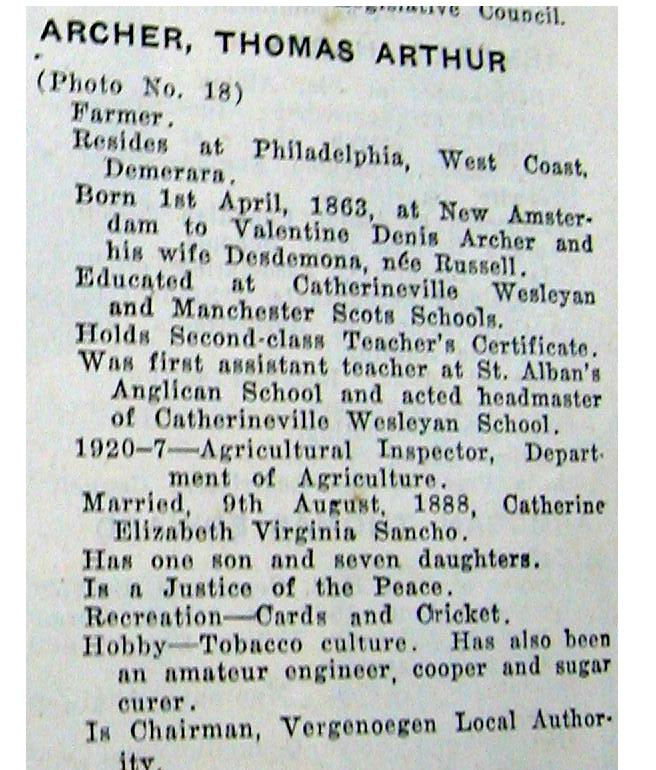
Mr. Thomas Arthur Archer J.P., Educator, Musician and Community Leader.
Mr. Thomas Arthur Archer is described as a well known personality, especially on the East and West Coasts of Demerara, where he laboured with outstanding sucess. Mr. Archer was born about 1861/62. Mr. Archer was an educator, a schoolmaster. Mr. Archer, replaced Mr. W. B. Johnson, and, served as the school master of Golden Grove Wesleyan School, 1886-1888. There were - 86 males and 38 females - 124 pupils on the register in 1886. The number increased to - 103 males and 58 females - 161 pupils, in 1888, when Mr. Archer was replaced as the Schoolmaster, by, James Alfred Trotman.
It is perhaps, while the School master of Golden Grove Wesleyan School, Mr. Archer, met Miss Catherine Elizabeth Sancho, whom he married on August 9, 1888. This Archer and Sancho union is known to issue eight off springs - one son and seven daughters - who survived the death of their father. They are the following; Thomas Eldad Archer; Chemist and Druggist, Mrs. Phyllis Kendall, Mrs. Dorothy Watson, Mrs. Gladys C. Wiltshire, Mrs. Ivy Nelbertha Loncke; Music Teacher, Mrs. Catherine Cole; School Teacher, Miss Boadicea Adina Archer; Registered Nurse and Midwife, and Miss Caroline Euphemia Archer; Registered Nurse and Midwife. The Sons-in-law of Mr. Thomas Arthur and Mrs. Catherine Elizabeth Archer are the following; Messrs:- Tennant Walter Kendall, Francis Percival Loncke, T. W. Watson, Sgt. O. D. H. Cole, and Reuben T.Wiltshire.
Mr. Archer served as the Schoolmaster, St. Mary's Scots School. Mrs. Catherine Archer, was an Assistant Teacher and the Sewing Mistress at St. Mary's School, Mahaica. Mr. Archer was a Deacon, Lay Cathechist and Organist of the St. Mary's Parish Church, in the Mahaica district, on the East Coast, of Demerara. Miss Souter was the organist at St. Peter's Church, Mahaicony. Jas. Orderson, Wm. Moffett, and Ed. Stanley Lord were deacons during this period.
School Master, Second Class Certificate, Golden Grove Wesleyan School, 1886-1888.
Schoolmaster, St. Mary's Scots School, Mahaica, East Coast, Demerara. ca. 1898.
Deacon, St. Mary's Scots Parish Church Mahaica, East Coast, Demerara.
Lay Cathechist, St. Mary's Scots Parish Church Mahaica, East Coast, Demerara.
Organists, St. Mary's Scots Parish Church Mahaica, East Coast, Demerara.
School Master, Anna Catharina Scots School, ca. 1902.
School Master, Philadelphia Scots School, ca. 1917.
Justice of the Peace
Chairman of Vergenoegen District
Executive Member, British Guiana Village Chairman Conference, ca. 1943.
Mr. Archer made the transition at the ripe age, 81 years old - to dwell among the ancestors, on Sunday, October 10, 1943, at his daughter, Mrs. Ivy Nelbertha Loncke's residence, 51 Robb and Albert Streets, Bourda, Georgetown, British Guiana.
It is perhaps, while the School master of Golden Grove Wesleyan School, Mr. Archer, met Miss Catherine Elizabeth Sancho, whom he married on August 9, 1888. This Archer and Sancho union is known to issue eight off springs - one son and seven daughters - who survived the death of their father. They are the following; Thomas Eldad Archer; Chemist and Druggist, Mrs. Phyllis Kendall, Mrs. Dorothy Watson, Mrs. Gladys C. Wiltshire, Mrs. Ivy Nelbertha Loncke; Music Teacher, Mrs. Catherine Cole; School Teacher, Miss Boadicea Adina Archer; Registered Nurse and Midwife, and Miss Caroline Euphemia Archer; Registered Nurse and Midwife. The Sons-in-law of Mr. Thomas Arthur and Mrs. Catherine Elizabeth Archer are the following; Messrs:- Tennant Walter Kendall, Francis Percival Loncke, T. W. Watson, Sgt. O. D. H. Cole, and Reuben T.Wiltshire.
Mr. Archer served as the Schoolmaster, St. Mary's Scots School. Mrs. Catherine Archer, was an Assistant Teacher and the Sewing Mistress at St. Mary's School, Mahaica. Mr. Archer was a Deacon, Lay Cathechist and Organist of the St. Mary's Parish Church, in the Mahaica district, on the East Coast, of Demerara. Miss Souter was the organist at St. Peter's Church, Mahaicony. Jas. Orderson, Wm. Moffett, and Ed. Stanley Lord were deacons during this period.
School Master, Second Class Certificate, Golden Grove Wesleyan School, 1886-1888.
Schoolmaster, St. Mary's Scots School, Mahaica, East Coast, Demerara. ca. 1898.
Deacon, St. Mary's Scots Parish Church Mahaica, East Coast, Demerara.
Lay Cathechist, St. Mary's Scots Parish Church Mahaica, East Coast, Demerara.
Organists, St. Mary's Scots Parish Church Mahaica, East Coast, Demerara.
School Master, Anna Catharina Scots School, ca. 1902.
School Master, Philadelphia Scots School, ca. 1917.
Justice of the Peace
Chairman of Vergenoegen District
Executive Member, British Guiana Village Chairman Conference, ca. 1943.
Mr. Archer made the transition at the ripe age, 81 years old - to dwell among the ancestors, on Sunday, October 10, 1943, at his daughter, Mrs. Ivy Nelbertha Loncke's residence, 51 Robb and Albert Streets, Bourda, Georgetown, British Guiana.
Sunday, January 23, 2005
Friday, January 14, 2005
The Ethos and Values of the early Freedmen
The Ethos and Values of the early Freedmen
by Pat Dial
Though the British Government had legally abolished Slavery on August 1, 1833, the institution was in essence continued by the Apprenticeship System which was only ended on August 1, 1838. Both anniversaries are celebrated on the First Monday of August – August Monday.
The story of the struggle for Emancipation is well-known but what is almost unknown is the more important and interesting saga of how the ex-slaves—the freedmen—constructed a rich and valid Way of Life out of the ruins and ashes of slavery. The creativity and resourcefulness which they brought to this almost impossible task of reconstruction is both a source of astonishment and pride to modern-day Guyanese.
The first challenge was economic. The planter Class hoped, indeed expected, the freedmen to stay on as day labourers on the Plantations and imagined that the pre- Emancipation labour relations would continue. But, the freedmen with an unexpected shrewdness, demanded adequate wages. More surprisingly, with a dignity and a courage which few believed they possessed, they began to move off the plantations and create their own village settlements. The planters regarded such independence of spirit as an affront.
VILLAGE MOVEMENT
The “Village Movement” remains one of the proud episodes of Guyanese History: In the 1840’s, owing to depressive state of the Sugar industry, many plantations were being abandoned or put up for sale. Groups of freedmen pooled their small savings which they had painstakingly accumulated over several years and begun purchasing these abandoned estates: Queenstown in Essequibo, and Victoria and Buxton in Demerara were among the first such places purchased.
The purchase prices paid for most of these abandoned estates were high and considering their poor or non-existent infrastructure, their owners made a rip-off. The freedmen, however, never complained of these “raw deals” but immediately embarked upon dividing up the land among the families and individuals who had purchased, co-operatively built their houses and began to try to build roads and drainage works. They also began planting food crops such as cassava, potatoes, yams, plantain, and breadfruit. A moderately prosperous future seemed to await these new Afro-Guyanese villages.
Prosperity, however, kept eluding them for they were consistently plagued by disaster. The lack of drainage and irrigation, the hostility of the neighbouring sugar planters and the neglect of the governmental authorities prevented the promised economic potentials of these villages from developing. Yet, the freedmen tenaciously held on and persisted in the struggle for existence.
The Way of Life which was developed in these villages was rich and distinctive. It drew from an African past and a European present and was eminently civilized, despite the hard struggle for economic survival.
There was a strong “work ethic” among these early freedmen. This may surprise many, as the usual popular and even historic stereotype was that they avoided hard work.
Both men and women laboured in the fields and in every village there were hard-working tradesmen such as tin-smiths, black-smiths, wheelwrights, tailors, carpenters and furniture-makers.
EDUCATION
Though many of these early African villagers were unlettered, they all had the greatest respect for learning and education. Education was not easily available – the founding of primary schools by the church denominations was only just about to begin. Yet parents try to have their children learn the “Three R’s” by whatever means possible. It was this respect for learning and these early efforts which laid the foundation for the intellectual flowering which these villages enjoyed for most of the 19th and 20th centuries.
These villages produced the schoolmasters and teachers, the intellectuals and professionals who were to make such an invaluable contribution to the growth of the Guyanese nation. The list of the men and women of learning produced by the village of Buxton, for example reads like a national honour roll.
These basic reading in the 1840’s and through the 19th century was the King James Version of the Bible and Shakespeare. Whenever current Victorian writing such as the Brontes or George Elliot or Hardy became available, these were avidly read. The result of this was that these freedmen became proficient in the English Language and many spoke it much better than the members of the Planter Class. Books were generally much valued and each family would aspire to have as many books as possible – even school books.
Religion was much respected and everyone went to church. These freedmen and their immediate descendants were God-fearing people who took the ethical rules of the Bible with great seriousness. Everyone sung hymns and small children were well acquainted with Biblical stories such as the Prodigal Son. This background of religion gave an inward discipline and courage to these villagers.
Good manners were studiously cultivated and this was evidenced in the hospitality and generosity with which they treated strangers. Food was always offered to a visitor.
The cuisine developed in these early Afro-Guyanese villages was also distinctive. This included the various types of pones, koneke (which could be used as both a desert and a substantial meal), and the numerous ways in which ground provisions and bananas and plantains could be prepared. Cakes of various kinds were a specialty. Many types of drinks were developed or prepared in a special way. Such drinks included sorrel, mauby, ginger beer and a variety of “wines” such as rice, psidium, gooseberry and jamoon.
EGALITARIAN
These freedmen improvised their own entertainment. Each village had its own band, the usual instruments being drums of various kinds, banjo and guitar. But it was in the enchanted world of story-telling that most found the greatest joy, especially the children. The repertoire of stories included the well-known “Nancy stories,” stories dealing with moral and social themes, and hair-raising “jumbie” stories. The famous moonlight sessions of such story-telling remained embedded in the unconscious memory of generations of Guyanese.
These Villagers were egalitarian to a fault and could never tolerate anyone feeling he or she were better than another. Each man was prepared to represent his case to the highest of forums, including the Governor himself. Leadership qualities were widespread and there were an amazing number of natural leaders in these communities. The highest integrity was regarded as a norm in anyone aspiring to be a leader and such integrity was cultivated and strengthened. Eusi Kwayana could be regarded as falling within this tradition of leadership.
These freedmen and their immediate descendants were intensely patriotic to their villages and also to their country.
As one reflects upon the celebration of August Monday one realizes that the ethos manifested by the early Afro-Guyanese freedmen is worthwhile to recapture and could be of great significance in the continuous task of Guyanese nation-building.
Source:
Pat Dial “The Ethos and Values of the early Freedmen” the Sunday Chronicle - August 4, 1991: Page 8.
by Pat Dial
Though the British Government had legally abolished Slavery on August 1, 1833, the institution was in essence continued by the Apprenticeship System which was only ended on August 1, 1838. Both anniversaries are celebrated on the First Monday of August – August Monday.
The story of the struggle for Emancipation is well-known but what is almost unknown is the more important and interesting saga of how the ex-slaves—the freedmen—constructed a rich and valid Way of Life out of the ruins and ashes of slavery. The creativity and resourcefulness which they brought to this almost impossible task of reconstruction is both a source of astonishment and pride to modern-day Guyanese.
The first challenge was economic. The planter Class hoped, indeed expected, the freedmen to stay on as day labourers on the Plantations and imagined that the pre- Emancipation labour relations would continue. But, the freedmen with an unexpected shrewdness, demanded adequate wages. More surprisingly, with a dignity and a courage which few believed they possessed, they began to move off the plantations and create their own village settlements. The planters regarded such independence of spirit as an affront.
VILLAGE MOVEMENT
The “Village Movement” remains one of the proud episodes of Guyanese History: In the 1840’s, owing to depressive state of the Sugar industry, many plantations were being abandoned or put up for sale. Groups of freedmen pooled their small savings which they had painstakingly accumulated over several years and begun purchasing these abandoned estates: Queenstown in Essequibo, and Victoria and Buxton in Demerara were among the first such places purchased.
The purchase prices paid for most of these abandoned estates were high and considering their poor or non-existent infrastructure, their owners made a rip-off. The freedmen, however, never complained of these “raw deals” but immediately embarked upon dividing up the land among the families and individuals who had purchased, co-operatively built their houses and began to try to build roads and drainage works. They also began planting food crops such as cassava, potatoes, yams, plantain, and breadfruit. A moderately prosperous future seemed to await these new Afro-Guyanese villages.
Prosperity, however, kept eluding them for they were consistently plagued by disaster. The lack of drainage and irrigation, the hostility of the neighbouring sugar planters and the neglect of the governmental authorities prevented the promised economic potentials of these villages from developing. Yet, the freedmen tenaciously held on and persisted in the struggle for existence.
The Way of Life which was developed in these villages was rich and distinctive. It drew from an African past and a European present and was eminently civilized, despite the hard struggle for economic survival.
There was a strong “work ethic” among these early freedmen. This may surprise many, as the usual popular and even historic stereotype was that they avoided hard work.
Both men and women laboured in the fields and in every village there were hard-working tradesmen such as tin-smiths, black-smiths, wheelwrights, tailors, carpenters and furniture-makers.
EDUCATION
Though many of these early African villagers were unlettered, they all had the greatest respect for learning and education. Education was not easily available – the founding of primary schools by the church denominations was only just about to begin. Yet parents try to have their children learn the “Three R’s” by whatever means possible. It was this respect for learning and these early efforts which laid the foundation for the intellectual flowering which these villages enjoyed for most of the 19th and 20th centuries.
These villages produced the schoolmasters and teachers, the intellectuals and professionals who were to make such an invaluable contribution to the growth of the Guyanese nation. The list of the men and women of learning produced by the village of Buxton, for example reads like a national honour roll.
These basic reading in the 1840’s and through the 19th century was the King James Version of the Bible and Shakespeare. Whenever current Victorian writing such as the Brontes or George Elliot or Hardy became available, these were avidly read. The result of this was that these freedmen became proficient in the English Language and many spoke it much better than the members of the Planter Class. Books were generally much valued and each family would aspire to have as many books as possible – even school books.
Religion was much respected and everyone went to church. These freedmen and their immediate descendants were God-fearing people who took the ethical rules of the Bible with great seriousness. Everyone sung hymns and small children were well acquainted with Biblical stories such as the Prodigal Son. This background of religion gave an inward discipline and courage to these villagers.
Good manners were studiously cultivated and this was evidenced in the hospitality and generosity with which they treated strangers. Food was always offered to a visitor.
The cuisine developed in these early Afro-Guyanese villages was also distinctive. This included the various types of pones, koneke (which could be used as both a desert and a substantial meal), and the numerous ways in which ground provisions and bananas and plantains could be prepared. Cakes of various kinds were a specialty. Many types of drinks were developed or prepared in a special way. Such drinks included sorrel, mauby, ginger beer and a variety of “wines” such as rice, psidium, gooseberry and jamoon.
EGALITARIAN
These freedmen improvised their own entertainment. Each village had its own band, the usual instruments being drums of various kinds, banjo and guitar. But it was in the enchanted world of story-telling that most found the greatest joy, especially the children. The repertoire of stories included the well-known “Nancy stories,” stories dealing with moral and social themes, and hair-raising “jumbie” stories. The famous moonlight sessions of such story-telling remained embedded in the unconscious memory of generations of Guyanese.
These Villagers were egalitarian to a fault and could never tolerate anyone feeling he or she were better than another. Each man was prepared to represent his case to the highest of forums, including the Governor himself. Leadership qualities were widespread and there were an amazing number of natural leaders in these communities. The highest integrity was regarded as a norm in anyone aspiring to be a leader and such integrity was cultivated and strengthened. Eusi Kwayana could be regarded as falling within this tradition of leadership.
These freedmen and their immediate descendants were intensely patriotic to their villages and also to their country.
As one reflects upon the celebration of August Monday one realizes that the ethos manifested by the early Afro-Guyanese freedmen is worthwhile to recapture and could be of great significance in the continuous task of Guyanese nation-building.
Source:
Pat Dial “The Ethos and Values of the early Freedmen” the Sunday Chronicle - August 4, 1991: Page 8.
Thursday, December 30, 2004
Announcements: Died - Elliott and Sancho
Died
SANCHO:- On Saturday, 13th. Inst., at Nabaclis, East Coast, Demerara, LAMMIE, the beloved husband of Annie Sancho, and father of Winnie, Tommy, Ruby, Magnel and Ileane.
Funeral at 4 o’clock, today.
Friends please accept this the only intimation.
Source:
The Daily Argosy, Georgetown, British Guiana, Sunday, September 14th., 1924 : page 4.
Elliott – On Monday, September 13th., 1948 at her residence, Nabaclis Village, East Coast, Demerara, Mrs. Annie Sophia, relict of T. J. Elliott, retired schoolmaster, Mother of Edward, Henry, Sydney and Wilfred Elliott, and Mesdames H. Bradshaw, S. Willis, and M. Patterson, and sister of Miss Sarah Sandy, retired School teacher.
The funeral will remove from the house of mourning - Nabaclis Village – to Victoria Roman Catholic church for the funeral service, and back to Nabaclis cemetery for interment at 4.00 p.m., today.
Relatives and friends are asked to accept this intimation.
Source:
The Daily Argosy, Georgetown, British Guiana, Tuesday, September 14th., 1948 : page 5.
SANCHO:- On Saturday, 13th. Inst., at Nabaclis, East Coast, Demerara, LAMMIE, the beloved husband of Annie Sancho, and father of Winnie, Tommy, Ruby, Magnel and Ileane.
Funeral at 4 o’clock, today.
Friends please accept this the only intimation.
Source:
The Daily Argosy, Georgetown, British Guiana, Sunday, September 14th., 1924 : page 4.
Elliott – On Monday, September 13th., 1948 at her residence, Nabaclis Village, East Coast, Demerara, Mrs. Annie Sophia, relict of T. J. Elliott, retired schoolmaster, Mother of Edward, Henry, Sydney and Wilfred Elliott, and Mesdames H. Bradshaw, S. Willis, and M. Patterson, and sister of Miss Sarah Sandy, retired School teacher.
The funeral will remove from the house of mourning - Nabaclis Village – to Victoria Roman Catholic church for the funeral service, and back to Nabaclis cemetery for interment at 4.00 p.m., today.
Relatives and friends are asked to accept this intimation.
Source:
The Daily Argosy, Georgetown, British Guiana, Tuesday, September 14th., 1948 : page 5.
Thursday, December 23, 2004
Golden Grove Celebrates Centenary As Village
B.G. News
Golden Grove Celebrates Centenary As Village
Initiative and Self-Help of Inhabitants Praised.
His Excellency Unveils Memorial Tablet
WHEN the Centenary celebrations of the purchase of Golden Grove, East Coast, Demerara, by 50 manumitted slaves, were opened on Wednesday last His Excellency the Governor, Sir Charles Woolley, K.C.M.G., O.B.E., M.C., and Lady Woolley, were among the chief guests.
IN THE COURSE of a heartening and congratulatory address. His Excellency declared that his greatest interest in British Guiana was directed towards the welfare of the rural areas, and much of his time was occupied with the solution of problems for the benefit of these areas. The prosperity of British Guiana depended mostly upon what it produced, and he was glad that Golden Grove was in the front rank in farming activities.
DESCRIBED by the Governor as the “Apostle of the Villages,” Mr. M. B. Laing, C.M.G., O.B.E., in his address stressed the important responsibility placed upon Village Councillors and urged villagers to give full co-operation for the advancement of the Village in every respect.
Mr. L. D. Sarrabo, prominent villager of Golden Grove was the reciptent of congratulations on the historical review of Golden Grove Village prepared and read by him at the first day’s celebration of the Centenary.
REVIEW OF PROGESS
The review covered the progress of the Village from the time of its purchase on May 5, 1848, by 50 manumitted slaves, to the present time, and included a record of the career of sons and daughters of Golden Grove who, during that period had gained special achievements. This historical review is published elsewhere in this issue, and, as was suggested by His Excellency deserves a place in the archives of the Colony.
On Wednesday afternoon, after the reading of the review, a Memorial tablet erected on the grounds of the Methodist Church at Golden Grove, was unveiled by His Excellency. On the Memorial tablet is inscribed the names of His Excellency the Governor, Messrs. M. B. Laing, C.M.G., Commissioner of Local Government, F. St.M. Gerrard, District Commissioner and the Chairman and Councillors of Golden Grove-Nabaclis Village.
HIS EXCELLENCY’S ADDRESS
Returning to the dais after Mr. H. A. Hughes, Chairman, had welcomed His Excellency, Lady Woolley, and the other guests, His Excellency addressed the gathering.
He said that as he drove into the village it was inspiring to see the great concourse of people gathered for the festive occasion. Expressing thanks for the warm welcome he and Lady Woolley had received, His Excellency said it gave them pleasure to attend and take part in the Centenary celebration of Golden Grove Village.
He felt it a duty, in spite of the many preoccupations, to be present. His interest in the rural areas was pre-eminent. The prosperity of British Guiana depended mostly on what it produced, and much of his time was spent in solving problems for the welfare of the country districts. There was exhibited at times a good deal of impatience to get certain things done, but before Government launched a scheme, it had to be examined carefully for assurance that the scheme was sound and on sure foundation.
On such an occasion as a Centenary celebration, His Excellency said it was well to review what progress had been made over the period of a hundred years. It would have been a good thing if the 50 pioneers of the Village had been alive to see how their original plans were carried out and improved. He referred to the Historical Review by Mr. Sarrabo, congratulated him on its preparation, and expressed the hope that it would find a place in the archives at the Public Buildings, Georgetown.
His Excellency went on to trace the evolution and progress of Local Administration, and said he was pleased of the information that the village played an important part in the agricultural activities of British Guiana. Much of the progress the village had achieved was due to the initiative of its inhabitants and their quality of self-help.
He extended warm congratulations to the community on the attainment of a hundred years’ existence and ended by wishing the Village continued prosperity to such a degree as would make it more worthy of the name.
MR. LAING “APOSTLE OF VILLAGES”
Sir Charles then introduced the next speaker whom he termed the “Apostle of the Villages,” and that was Mr. Laing.
After expressing pleasure at being present, and gratitude for the invitation, Mr. Laing added tribute to Mr. Sarrabo for his interesting historical review.
He said he had listened with great interest to His Excellency’s address and endorsed all that had been said by him. The past, Mr. Laing said, had taught much, but the future was more important still. The present generation had to continue building on the foundation that was well and truly laid by the stalwarts of the past. Much had been done but there was much still to be done. He then stressed the important function that Village Councils had to undertake and emphasized the sacrifical voluntary work done by the several Village Councillors.
Mr. Laing went on to urge the villagers to give full co-operation to the Council, take pride in their village, and strive to build a better and brighter Golden Grove in every respect. He referred to the necessary amenities such as a Community centre, a market, electric lighting and playing fields; but said that the village must not be regarded merely as an avenue for picnics, but moreso as the home and working ground of those who follow agricultural pursuits. It must be made sure that “ he who tills the soil is making a good living.” He added that Village Councillors had ample opportunity and privilege of developing a full understanding of the requirements of the people of their community, and to guide them towards a fuller life – materially and spiritually.
BUILDING BETTER GOLDEN GROVE
Concluding, Mr. Laing said he joined in homage and gratitude to the memory of the men who founded the Village of Golden Grove, a hundred years ago and he enjoined the present villagers and those to come to grasp every opportunity with both hands and strive to build a yet better Golden Grove.
The Hon. D. P. Debidin, said he was happy for the honour and privilege of being associated with the celebration of the centenary of the existence of Golden Grove as a village. He was deeply impressed by the historical review and thought the villagers should be proud to have Mr. L. D. Sarrabo to compile so compact a history.
The occasion said Mr. Debidin, was an auspicious one and a fitting time for checking up on past achievements and decideing what further should be done during the next hundred years to improve further, conditions at Golden Grove.
After stressing the need of better drainage and irrigation, better housing, trade schools for senior boys and girls, he emphasized that farming, well carried on, was of great prosperity. He deplored the exodus of people from the rural areas to the city, where the struggle for existence was extremely keen and opportunity for earning a good livelihood precarious.
Finally, he advised the rising generation to emulate their forbearers who, through thrift, unity, love, and reverence to God had enabled such a laudable heritage to be handed down.
DIVINE SERVICE
During the morning a large gathering of villagers and friends from various parts of the Colony assembled in the Methodist Church of the village where an impressive service was held and a fitting sermon preached by the Rev. S. W. C. Crosse.
At intervals, musical contributions were rendered by the Militia Band, and among the hymns sung by the congregation were:- “Praise my soul the king of Heaven”, “O God our help in Ages past”, and “Now thank we all our God.” Mr. D. A. Trotman the schoolmaster of the village officiated at the organ.
THE SERMON
Rev. Crosse after extending on behalf of the villagers a hearty welcome to the visitors including Major Henwood and his band, took his text from Psalm 108, verse 8; “Oh that men would praise the Lord for his goodness and for his wonderful works to the children of men.”
He paid a glowing tribute to the vision and foresight of the founders of the village who carried through so noble and laudable a project, although they had been released from slavery not so many years past. Their foresight and thrift, their love and unity, their faith in God, were the qualities which led them to so fruitful a venture.
It was of interest to note how early they set apart a vast portion of land to erect a Church where they could worship God. It was fitting said the preacher, to be assembled as they were, to give praise to Almighty God for the heritage into which the succeeding generations of the Village had come.
A CHALLENGE
The occasion that day was a challenge to the present and future villagers to emulate the virtues, wisdom, love, unity and reverence to God and strive to “Present your bodies a living sacrifice, holy and acceptable to God which is your reasonable service.”
the preacher concluded with the immortal lines of Longfellow:
“Lives of great men all remind us
we can make our lives sublime
And departing leave behind us
Footprints on the sands of time.”
The sermon ended, the “te Deum” was sung, and after the recitation of a General Thanksgiving by the assembly, led by the Minister, the singing of the National Anthem brought the service to an end.
Source:
The Daily Argosy, Friday, May 7th. 1948: page 4 and 6.
Golden Grove Celebrates Centenary As Village
Initiative and Self-Help of Inhabitants Praised.
His Excellency Unveils Memorial Tablet
WHEN the Centenary celebrations of the purchase of Golden Grove, East Coast, Demerara, by 50 manumitted slaves, were opened on Wednesday last His Excellency the Governor, Sir Charles Woolley, K.C.M.G., O.B.E., M.C., and Lady Woolley, were among the chief guests.
IN THE COURSE of a heartening and congratulatory address. His Excellency declared that his greatest interest in British Guiana was directed towards the welfare of the rural areas, and much of his time was occupied with the solution of problems for the benefit of these areas. The prosperity of British Guiana depended mostly upon what it produced, and he was glad that Golden Grove was in the front rank in farming activities.
DESCRIBED by the Governor as the “Apostle of the Villages,” Mr. M. B. Laing, C.M.G., O.B.E., in his address stressed the important responsibility placed upon Village Councillors and urged villagers to give full co-operation for the advancement of the Village in every respect.
Mr. L. D. Sarrabo, prominent villager of Golden Grove was the reciptent of congratulations on the historical review of Golden Grove Village prepared and read by him at the first day’s celebration of the Centenary.
REVIEW OF PROGESS
The review covered the progress of the Village from the time of its purchase on May 5, 1848, by 50 manumitted slaves, to the present time, and included a record of the career of sons and daughters of Golden Grove who, during that period had gained special achievements. This historical review is published elsewhere in this issue, and, as was suggested by His Excellency deserves a place in the archives of the Colony.
On Wednesday afternoon, after the reading of the review, a Memorial tablet erected on the grounds of the Methodist Church at Golden Grove, was unveiled by His Excellency. On the Memorial tablet is inscribed the names of His Excellency the Governor, Messrs. M. B. Laing, C.M.G., Commissioner of Local Government, F. St.M. Gerrard, District Commissioner and the Chairman and Councillors of Golden Grove-Nabaclis Village.
HIS EXCELLENCY’S ADDRESS
Returning to the dais after Mr. H. A. Hughes, Chairman, had welcomed His Excellency, Lady Woolley, and the other guests, His Excellency addressed the gathering.
He said that as he drove into the village it was inspiring to see the great concourse of people gathered for the festive occasion. Expressing thanks for the warm welcome he and Lady Woolley had received, His Excellency said it gave them pleasure to attend and take part in the Centenary celebration of Golden Grove Village.
He felt it a duty, in spite of the many preoccupations, to be present. His interest in the rural areas was pre-eminent. The prosperity of British Guiana depended mostly on what it produced, and much of his time was spent in solving problems for the welfare of the country districts. There was exhibited at times a good deal of impatience to get certain things done, but before Government launched a scheme, it had to be examined carefully for assurance that the scheme was sound and on sure foundation.
On such an occasion as a Centenary celebration, His Excellency said it was well to review what progress had been made over the period of a hundred years. It would have been a good thing if the 50 pioneers of the Village had been alive to see how their original plans were carried out and improved. He referred to the Historical Review by Mr. Sarrabo, congratulated him on its preparation, and expressed the hope that it would find a place in the archives at the Public Buildings, Georgetown.
His Excellency went on to trace the evolution and progress of Local Administration, and said he was pleased of the information that the village played an important part in the agricultural activities of British Guiana. Much of the progress the village had achieved was due to the initiative of its inhabitants and their quality of self-help.
He extended warm congratulations to the community on the attainment of a hundred years’ existence and ended by wishing the Village continued prosperity to such a degree as would make it more worthy of the name.
MR. LAING “APOSTLE OF VILLAGES”
Sir Charles then introduced the next speaker whom he termed the “Apostle of the Villages,” and that was Mr. Laing.
After expressing pleasure at being present, and gratitude for the invitation, Mr. Laing added tribute to Mr. Sarrabo for his interesting historical review.
He said he had listened with great interest to His Excellency’s address and endorsed all that had been said by him. The past, Mr. Laing said, had taught much, but the future was more important still. The present generation had to continue building on the foundation that was well and truly laid by the stalwarts of the past. Much had been done but there was much still to be done. He then stressed the important function that Village Councils had to undertake and emphasized the sacrifical voluntary work done by the several Village Councillors.
Mr. Laing went on to urge the villagers to give full co-operation to the Council, take pride in their village, and strive to build a better and brighter Golden Grove in every respect. He referred to the necessary amenities such as a Community centre, a market, electric lighting and playing fields; but said that the village must not be regarded merely as an avenue for picnics, but moreso as the home and working ground of those who follow agricultural pursuits. It must be made sure that “ he who tills the soil is making a good living.” He added that Village Councillors had ample opportunity and privilege of developing a full understanding of the requirements of the people of their community, and to guide them towards a fuller life – materially and spiritually.
BUILDING BETTER GOLDEN GROVE
Concluding, Mr. Laing said he joined in homage and gratitude to the memory of the men who founded the Village of Golden Grove, a hundred years ago and he enjoined the present villagers and those to come to grasp every opportunity with both hands and strive to build a yet better Golden Grove.
The Hon. D. P. Debidin, said he was happy for the honour and privilege of being associated with the celebration of the centenary of the existence of Golden Grove as a village. He was deeply impressed by the historical review and thought the villagers should be proud to have Mr. L. D. Sarrabo to compile so compact a history.
The occasion said Mr. Debidin, was an auspicious one and a fitting time for checking up on past achievements and decideing what further should be done during the next hundred years to improve further, conditions at Golden Grove.
After stressing the need of better drainage and irrigation, better housing, trade schools for senior boys and girls, he emphasized that farming, well carried on, was of great prosperity. He deplored the exodus of people from the rural areas to the city, where the struggle for existence was extremely keen and opportunity for earning a good livelihood precarious.
Finally, he advised the rising generation to emulate their forbearers who, through thrift, unity, love, and reverence to God had enabled such a laudable heritage to be handed down.
DIVINE SERVICE
During the morning a large gathering of villagers and friends from various parts of the Colony assembled in the Methodist Church of the village where an impressive service was held and a fitting sermon preached by the Rev. S. W. C. Crosse.
At intervals, musical contributions were rendered by the Militia Band, and among the hymns sung by the congregation were:- “Praise my soul the king of Heaven”, “O God our help in Ages past”, and “Now thank we all our God.” Mr. D. A. Trotman the schoolmaster of the village officiated at the organ.
THE SERMON
Rev. Crosse after extending on behalf of the villagers a hearty welcome to the visitors including Major Henwood and his band, took his text from Psalm 108, verse 8; “Oh that men would praise the Lord for his goodness and for his wonderful works to the children of men.”
He paid a glowing tribute to the vision and foresight of the founders of the village who carried through so noble and laudable a project, although they had been released from slavery not so many years past. Their foresight and thrift, their love and unity, their faith in God, were the qualities which led them to so fruitful a venture.
It was of interest to note how early they set apart a vast portion of land to erect a Church where they could worship God. It was fitting said the preacher, to be assembled as they were, to give praise to Almighty God for the heritage into which the succeeding generations of the Village had come.
A CHALLENGE
The occasion that day was a challenge to the present and future villagers to emulate the virtues, wisdom, love, unity and reverence to God and strive to “Present your bodies a living sacrifice, holy and acceptable to God which is your reasonable service.”
the preacher concluded with the immortal lines of Longfellow:
“Lives of great men all remind us
we can make our lives sublime
And departing leave behind us
Footprints on the sands of time.”
The sermon ended, the “te Deum” was sung, and after the recitation of a General Thanksgiving by the assembly, led by the Minister, the singing of the National Anthem brought the service to an end.
Source:
The Daily Argosy, Friday, May 7th. 1948: page 4 and 6.
HISTORICAL REVIEW OF GOLDEN GROVE VILLAGE
B.G. News
HISTORICAL REVIEW OF GOLDEN GROVE VILLAGE
EVENTS, IMPROVEMENTS AND ACHIEVEMENTS, 1848 -1948.
Following is the historical review of the Golden Grove Village, East Coast, Demerara, covering the period of its acquisition as a village from May 5, 1848 to May 5, 1948, compiled and read by Mr. L. D. Sarrabo, a villager and former chairman of the Village Council, on the occasion of the opening of the centenary celebrations on Wednesday last, in the presence of His Excellency the Governor, and a number of prominent citizens.
May it please Your Excellency, Gentlemen: To-day a deep sense of joy and happiness thrills me because of the privilege and honour that are accorded to me to read a review showing the events, improvements and achievements which have taken place in various aspects in the life of the people over the years from 1848 to 1948.
SALE OF VILLAGE
On January 5, 1848, fifty men, good and true, pooled their resources and subscribed one hundred dollars each and bought Plantation Williamsburg for the sum of five thousand dollars. Robert Straker Turton, the owner of the Plantation, was approached by Charles William Cleeve through his attorney, William Heath, and bought the Plantation for and behalf of the fifty proprietors. Soon after this, the name Williamsburg was changed to Golden Grove, as it is this day.
Following are the names of the proprietors:-
Prince Grant; Juptier Quashey; Lina Hercules; John Sumner; Bentick Sancho; Filbert Horatio; Cheesewright Josiah; Ben Conwright; Sophy David; Leah Giles; James Smith; Rowland Chester; Job Timmany; Luke Philip and Gotina Stout; Bristol Newport; Philip Daniel; Tuckness Sancho; Quashey Luke, and Prince Asan; Benjamin Solomon; Robert Europe; Wellington Rogers; Sambo Sumner and Quammy David; Andrew Lexey; Joseph Beard; Sam Sarrabo; Blackwell Simon; Frederick Hope; Billy George; Frank Seaforth; Grenville Green; Billy Billieson; Duke Cato; George Jack; Charles Christmas; Diamond Chester; Stewart Smith; Daniel Virgil and Margaret McArthur; Sam Dick and Jack Newport; Sammy Richard; Sampson Collins; Douglas Hector and James Simon and George Timmany.
This sale, after being carried out, remained in the hands of the proprietors until January 1850, when, at their request a survey was made by Francis Jackson, Sworn Land Surveyor.
This survey was subdivided into building allotments for a Village. Each allotment is eleven and a half rods wide and twelve rods in depth equal to 138 square rods.
At the time of the allotment, it was a very happy gesture on the part of the proprietors, to mark off Lot No#. 5 with a measurement of 25 rods in depth and 16 rods in width equal to 450 square rods, and to give it over to the Wesleyan Missionary Society for Church and school purposes.
To-day, this is Lot No#. 5 on which we stand and celebrate our Centenary.
Nor was this all, the proprietors, so thoughtful and generous were they to the Wesleyan Methodist Society that they made a further contribution of two lots extending from Kendall Street on the West to James’ Avenue by the railway station for the use and benefit of the said Society. A large piece of land, on the northern side by the sea was also reserved as pasturage for grazing their cows, sheep and goats.
This plan No. 2668 referred to by Jackson and executed to William Heath, as attorney of Charles William Cleeve was deposited in the Deeds Registry, on the eighteenth day of April 1850, and signed by J. H. Froster, senior sworn clerk, and notary public. Following on the Jackson survey, a more detailed, and up to date survey was carried out in 1873 by A. J. Alcorn, Sworn Land Surveyor.
ADMINISTRATION
In the early days of the proprietors, the village was administered under the Central Board of Health Ordinance, until it was superseded by Sir John Carrington’s Ordinance of 1892. This Ordinance brought about a change in the administration of the Villages.
Sir John so as to give the Villagers a good understanding of the working of the new Ordinance met them at St. Paul’s schoolroom and explained it to them.
An extract from the Official Gazette of March 4, 1893, reads as follows: - “it is hereby notified that the Village Councils of the under mentioned villages have been duly constituted under the Village Ordinance, 1892, and are composed respectively of elected and nominated members as hereinafter appears, and it is further notified that the Central Board of Health have appointed the persons whose names “are hereinafter mentioned to be Chairmen of the respective Village Councils”:-
Golden Grove and Nabaclis
Elected Members
Manoel Garoe Pitta- Chairman; Thomas Adams, Albert Massiah Benn, Lammy Tuckness Sancho, David Collins, Adam Ridley,
Nominated Members; E. London, James David.
(sgd.) Thomas Daly Secretary of Central Board of Health Dated Georgetown 3rd. March 1893. This was the composition of the first Council under the Village Ordinance of 1892. Then came the second and third Council of which Brandford Trotman and George Cockfield were Chairmen, respectively.
On 17th. July, 1923, to 31st. December, 1933, L. D. Sarrabo was Chairman of the District. During that period the following services were carried out for the good and welfare of the proprietors, generally:-
1. March 17 1924 Allotting and giving out Section 1, Golden Grove and Nabaclis, to the proprietors.
2. March 2, 1928 Installing and opening pumping plant at Nabaclis, by Sir Cecil Rodwell, K.C.M.G.
3. July 19, 1930 Empoldering and giving out Sections J and K – 400 acres- Golden Grove and Nabaclis,
to the proprietors.
4. January 1, 1932 Introduction of the Village Administration Scheme.
5. October 19, 1933 Opening of the Cane Industry Golden Grove and Nabaclis, by Sir
Edward Brandis Denham , K.C.M.G. and passing the first 16 acres of canes through
the right of way into the factory of Plantation Enmore to be made into sugar.
Then followed the succeeding Chairmen to the Council; J. R. Simon; Donald A. Trotman; C. P. Melbourne J.P.; Benjamin Kingston; C. F. Adams; J. C. Seeley; and the composition of the present Council.
ELECTED COUNCILLORS
H. A. Hughes, - Chairman; A. Fernandes, Deputy Chairman; S. L. Jeune; M. Fraser; T. H. Benn; and A. Mc Donald; D. A. Trotman; Nominated Councillors; C. P. Melbourne and T. R. Persaud.
During this period 1892 to 1945, many ordinances were introduced for the proper working of the Villages, among them being Ordinance 13 of 1907, which was superseded by the revised edition of the Laws of 1930, by Chapter 84 and finally that was superseded by the present Ordinance, No #. 14 of 1945.
AGRICULTURE
Golden Grove was always an Agricultural District, and Agriculture formed its background. The proprietors settled down in real earnest to agricultural pursuits. With them, there were no slack days. It was all work, work, work. They laboured faithfully from Monday to Saturday to achieve their aims and purposes, and soon made Golden Grove a hive of farming industry.
They took such keen interest in their farm holdings and produced such abundant crops of plantains, cassava, yams, potatoes and the like, that Golden Grove soon won for itself the appellation of the Granary of the East Coast.
They manifested great pride in farming because it brought them prosperity and independence and was regarded in every respect as a paying concern.
They built goodly two-storeyed houses and lived in them in comfort to themselves and their families.
It was the usual occurrence to see twenty to twenty-five trucks laden with sugar and syrup and ground provisions leave the siding at Golden Grove, every Monday afternoon for the City.
The people of that day were very enterprising and ambitious, and in 1872, Jimmy James erected a windmill on his lot at Golden Grove to make sugar and syrup. How well he succeeded in his business can be gauged by the fact that he received many orders for sugar (common process as it was called) and syrup from firms in Georgetown. In 1890, a steam plant for making sugar was put up by C. W. Wilson, and afterwards passed into the hands of Isaac Evelyn. There was such a progressive spirit among the people of that period that, Colin Hiles, applied to Government for a licence to distil rum at Golden Grove. The application was turned down on the ground that he had not one hundred acres of canes under cultivation.
PIONEERS OF AGRICULTURAL SHOWS
In August of 1894, Golden Grove was the first Village in the Colony to hold an Agricultural show. The next year, 1895, another show was held with equally successful results. In 1896, it took place at Victoria-Belfield under the aegis of the Victoria-Belfield Agricultural Society of which Mr. Barbour-James was President. From 1897 District Agricultural shows under the Department of Agriculture were held all over the Colony. Another outstanding feature of Golden Grove was a racecourse of its own. Some of the proprietors owned race-horses, and it was a glorious time when horses from far and near met the homesters and contested with one another for supremacy of place.
All these things happened because the proprietors enjoyed very good drainage, reaped excellent crops, and lived in a state of prosperity, independence and happiness.
At this closing year of Centenary the drainage question has become a problem to be solved, and I venture the expression that with good drainage, these same sturdy farmers of Golden Grove will stage a wonderful “Get back to the land” with the determination to win again the glorious past, and be reckoned as economic factors of the Country.
Before I pass on, I must make mention of the fact that, Golden Grove is the home of the “Famous Buxton Spice.” Several years ago, the market women of Buxton came here and bought the mango, took it to Georgetown, and sold it under the name and title of “Buxton Spice” which name it has retained up to this day. If it is not “Buxton Spice,” it is no mango – no market.
EDUCATION
In 1848, the first elementary school was opened in the Congregational Church at Victoria. The teacher was one, Boss Africa – a slave. He was taught to read and write by the early London Missionaries who came out here during the time of slavery. Boss Africa, being a very ambitious man, his fame as a teacher went far and wide and soon drew to his school a large number of boys from Golden Grove, Nabaclis and Victoria.
There can be no doubt that the boys showed some progress at reading and writing and were advanced into a Grammar class.
It happened on a certain Friday afternoon that Boss Africa wanting to test the boys’ prowess at parsing, called upon one of them and said, “Kenny, paus me the suntans Chan-clow (meaning Carrion Crow) flew Vap Vap” Kenny, not to be out done, and to show himself how smart a boy he was at parsing, sang out in a loud voice and said Carrion Crow flew Vap Vap, that is verb sir. Kenny’s answer was so satisfactory to Boss Africa that he sang out in a loud voice and said, “Good boy Kenny, smat boy fo’tru, you propa know gramma.”
That was the standard of education in those days.
If we compare it with our standard to-day, we would see what great improvements have taken place over the period of which we write and the great achievements accomplished by boys along that line.
As this review deals specifically with Golden Grove, I shall begin with boys of Golden Grove who have been outstanding and made a mark for themselves.
Scholarships: I shall now begin with Arnold McLean and Gobind Persaud; Both these boys received the baptism of their early education at the Wesleyan Methodist School at Golden Grove under the careful tuition of Mr. J. A. Trotman. McLean afterwards went to Cove and John school and there he improved his studies and won a County Scholarship, went to Queen’s and after three years of hard study, carried off the Guiana Scholarship. The next year he went to England and studied medicine.
Persaud remained with Mr. Trotman; won a County Scholarship, went to Queen’s and won the Guiana Scholarship, and took up the study of Law in England.
Next in line of scholarships is Samson N. Collins. He received his early education at Golden Grove Methodist school, and afterwards went to Cove and John at which school he won the first trade Bursary Scholarship in 1912.
He was apprenticed to the late G. N. Lord, and was awarded the Master Tailor Certificate by the Board of Industrial Training in 1918.
He studied with the Tailors and Cutters Academy in the West End and was awarded a Diploma as a Cutter.
In 1932-33, S. N. revisited England and interviewed the Secretary of state for the Colonies, in the colonial Office on matters concerning the establishment of minor industries in British Guiana.
Next in order of scholarships come Charles Jupiter, Stella Benjamin, Neville Barnwell, Waveney and Donald Trotman. All these have won the County scholarship. Waveney and Donald are now at Bishops’ High School and Queen’s respectively and doing well in their studies. We hope to hear of them, carrying off the Guiana Scholarship in due time.
There is another outstanding Golden Grove boy. I refer to Stanley E. Gomes, now His Majesty’s Attorney General in the Leeward Islands. He too had a sprinkling of his early Education at the Golden Grove Methodist school under Mr. J. A. Trotman.
Then come Donald Trotman and George H. Morrison. Both of them won the Student Teacher ship; went off to Mico College in Jamaica, studied 2 years and returned home.
George is an Assistant Inspector of Schools appointed by the Secretary of State for the Colonies and is now acting County Inspector of schools. Donald is the Head teacher of the Golden Grove Methodist school in succession to his father Mr. James A. Trotman, now retired after 36 years of service in that school.
Following on are R. A. Kendall, J. R. Simon, and Milton B. Trotman now chief steward at the Public Hospital, Suddie. Mention must also be made of Wady Simon, Assistant Inspector of Police, Thomas Ward and Oscar Hobbs. Thomas is now Sergeant of Police and Oscar, Lance-Corpl. Has just been awarded the Colonial Police and Fire Brigade Long Service Medal. We hope to see them climbing and reaching the topmost rung of the ladder of their department and making their mark. And what shall we say of Albert Glen? He is now Chief Guard of the Transport and Harbours Department. All these sons, and more, are the product of Golden Grove and passed through its school.
PROGRESS OF SCHOOL
Sir Crawford Douglas-Jones; C.M.G when acting Governor, offered prizes for the best papers on “History of the British Empire” to the primary schools throughout the Colony. The Golden Grove Methodist school on this occasion distinguished itself when Constance Ainsworth and Samuel Shepherd won both of the Governor’s prizes. By this brilliant and outstanding achievement, the school has again added new laurels to its number and covered itself with glory.
The school increased in number until 1936 an additional building had to be erected to accommodate the pupils.
At the opening of this building Major Bain Gray, then Director of Education, paid a glowing tribute to the Head teacher, “Mr. Trotman,” he said, “ not only helps by providing teachers for his own school but for many other schools in the Colony.” To-day, the school has on its roll a total approximating to 700 scholars.
The results of this school are very gratifying and year after year Mr. D. A. Trotman, the Head Teacher, is proving himself a very capable and efficient teacher of high standing. This school needs a library and press to teach boys the art of printing and running a monthly or quarterly magazine of its own. But these are not all. There should also, be an industrial side attached to such a school where boys and girls would be given an opportunity of obtaining proper training in the art of Tropical Agriculture so as to fit them for an agricultural life, that is farming, poultry rearing, butter making, canning and the carrying on of allied manufacturing industries to fit them for becoming worthy citizens.
CENTENARY SCHOLARSHIP
The Golden Grove and Nabaclis Village Council has under consideration (funds permitting) to found a Scholarship having an Agricultural background, to be called the Golden Grove Centenary Scholarship.
This Scholarship will afford boys the opportunity of entering the Imperial College of Tropical Agriculture in Trinidad and pursuing a course of studies.
I shall have failed in my duty if I close this review without mentioning the names of the heroes who did service in Egypt, France and Belgium in World War 1 of 1914-18. When the call of duty went out, “Your Country needs you,” 25 boys of Golden Grove enlisted for service to fight for King and Country. Their names are Matthias Harding; Arthur Pompey who rose to be Corporal; Arthur Rodney; John De Souza; Arnold Thomas; John Graham; Jimmy Hercules; Lionel Waterman; Tommy Kendall; Samuel Charles; Augustus Toney; Iris Lopes; Joseph Lopes; George Wilson; Thomas Lewis; Sway Sydney; B. Sydney; Willie Franklin; Reggie Rodney; Jephtah Glasgow; Thomas Eversley and 4 others whose names I cannot now recall.
Of this number, five of them, Corporal Arthur Pompey took ill in France, was sent home and died shortly after. His remains were interred in the Golden Grove Cemetery and a monument raised to his memory. Also Privates Matthias Harding, Lionel Waterman, Jimmy Hercules, and Arnold Thomas. These five boys made the supreme sacrifice and given their lives that others might live.
THANKS
I must first of all thank Your Excellency for coming and presiding over, and taking part in our Centenary Celebrations to-day. The Chairman in his address of welcome to Your Excellency very befittingly remarked that he knows how busy Your Excellency is at this time with all the upset and unrest of labour troubles which call for solution at Your Excellency’s hands. Yet in spite of all this, Your Excellency has found time to come to us. We highly appreciate and thank Your Excellency for honouring us with Your presence to-day. Next – comes Mr. Laing who is not a stranger to Golden Grove. He has been aptly described as the “Father of Village Administration.” But to-day with Mr. Laing’s permission, I wish to christen and give him a new name and call him the “Apostle of Village Administration.” Mr. Laing has given me every assistance and very readily placed all the records at my disposal. Mr. Laing has also advised and given me directions in making the Centenary Programme. For these services we offer and ask Mr. Laing’s acceptance of our sincerest thanks. Mr. Christiani, the veteran Secretary of the Local Government Board, when I approached him and asked for his help, he very readily and willingly prepared extracts of village administration which I have used to good effect in preparing this review. Mr. Christiani, has our sincerest thanks for all the services he has rendered us.
I shall not forget Mr. J. R. Muss. He also, was very helpful to me by placing at my disposal whatever records he knew would be of assistance to me. We heartily appreciate and thank Mr. Muss for his services. Last but not least comes Mr. Chase of the Deeds Registry. He gave up a portion of his breakfast hour and assisted me in getting out all the necessary information which I needed for this review. We offer to Mr. Chase our heartfelt thanks.
Finally, like Pope, we say “ Hope springs eternal in the human breast,” and so today, departing and leaving our footprints in the sand of time for others to follow, we hope that some Golden Grove boy worthier than I, will rise to the occasion and read the next Centenary historical review of 2048.
Thrice again, I thank Your Excellency and Gentlemen, for the patient hearing you have given to the reading of this historical review the historical review of the Centenary of Golden Grove, 1848 to 1948.
Source:
The Daily Argosy, Friday, May 7th. 1948: page 3.
HISTORICAL REVIEW OF GOLDEN GROVE VILLAGE
EVENTS, IMPROVEMENTS AND ACHIEVEMENTS, 1848 -1948.
Following is the historical review of the Golden Grove Village, East Coast, Demerara, covering the period of its acquisition as a village from May 5, 1848 to May 5, 1948, compiled and read by Mr. L. D. Sarrabo, a villager and former chairman of the Village Council, on the occasion of the opening of the centenary celebrations on Wednesday last, in the presence of His Excellency the Governor, and a number of prominent citizens.
May it please Your Excellency, Gentlemen: To-day a deep sense of joy and happiness thrills me because of the privilege and honour that are accorded to me to read a review showing the events, improvements and achievements which have taken place in various aspects in the life of the people over the years from 1848 to 1948.
SALE OF VILLAGE
On January 5, 1848, fifty men, good and true, pooled their resources and subscribed one hundred dollars each and bought Plantation Williamsburg for the sum of five thousand dollars. Robert Straker Turton, the owner of the Plantation, was approached by Charles William Cleeve through his attorney, William Heath, and bought the Plantation for and behalf of the fifty proprietors. Soon after this, the name Williamsburg was changed to Golden Grove, as it is this day.
Following are the names of the proprietors:-
Prince Grant; Juptier Quashey; Lina Hercules; John Sumner; Bentick Sancho; Filbert Horatio; Cheesewright Josiah; Ben Conwright; Sophy David; Leah Giles; James Smith; Rowland Chester; Job Timmany; Luke Philip and Gotina Stout; Bristol Newport; Philip Daniel; Tuckness Sancho; Quashey Luke, and Prince Asan; Benjamin Solomon; Robert Europe; Wellington Rogers; Sambo Sumner and Quammy David; Andrew Lexey; Joseph Beard; Sam Sarrabo; Blackwell Simon; Frederick Hope; Billy George; Frank Seaforth; Grenville Green; Billy Billieson; Duke Cato; George Jack; Charles Christmas; Diamond Chester; Stewart Smith; Daniel Virgil and Margaret McArthur; Sam Dick and Jack Newport; Sammy Richard; Sampson Collins; Douglas Hector and James Simon and George Timmany.
This sale, after being carried out, remained in the hands of the proprietors until January 1850, when, at their request a survey was made by Francis Jackson, Sworn Land Surveyor.
This survey was subdivided into building allotments for a Village. Each allotment is eleven and a half rods wide and twelve rods in depth equal to 138 square rods.
At the time of the allotment, it was a very happy gesture on the part of the proprietors, to mark off Lot No#. 5 with a measurement of 25 rods in depth and 16 rods in width equal to 450 square rods, and to give it over to the Wesleyan Missionary Society for Church and school purposes.
To-day, this is Lot No#. 5 on which we stand and celebrate our Centenary.
Nor was this all, the proprietors, so thoughtful and generous were they to the Wesleyan Methodist Society that they made a further contribution of two lots extending from Kendall Street on the West to James’ Avenue by the railway station for the use and benefit of the said Society. A large piece of land, on the northern side by the sea was also reserved as pasturage for grazing their cows, sheep and goats.
This plan No. 2668 referred to by Jackson and executed to William Heath, as attorney of Charles William Cleeve was deposited in the Deeds Registry, on the eighteenth day of April 1850, and signed by J. H. Froster, senior sworn clerk, and notary public. Following on the Jackson survey, a more detailed, and up to date survey was carried out in 1873 by A. J. Alcorn, Sworn Land Surveyor.
ADMINISTRATION
In the early days of the proprietors, the village was administered under the Central Board of Health Ordinance, until it was superseded by Sir John Carrington’s Ordinance of 1892. This Ordinance brought about a change in the administration of the Villages.
Sir John so as to give the Villagers a good understanding of the working of the new Ordinance met them at St. Paul’s schoolroom and explained it to them.
An extract from the Official Gazette of March 4, 1893, reads as follows: - “it is hereby notified that the Village Councils of the under mentioned villages have been duly constituted under the Village Ordinance, 1892, and are composed respectively of elected and nominated members as hereinafter appears, and it is further notified that the Central Board of Health have appointed the persons whose names “are hereinafter mentioned to be Chairmen of the respective Village Councils”:-
Golden Grove and Nabaclis
Elected Members
Manoel Garoe Pitta- Chairman; Thomas Adams, Albert Massiah Benn, Lammy Tuckness Sancho, David Collins, Adam Ridley,
Nominated Members; E. London, James David.
(sgd.) Thomas Daly Secretary of Central Board of Health Dated Georgetown 3rd. March 1893. This was the composition of the first Council under the Village Ordinance of 1892. Then came the second and third Council of which Brandford Trotman and George Cockfield were Chairmen, respectively.
On 17th. July, 1923, to 31st. December, 1933, L. D. Sarrabo was Chairman of the District. During that period the following services were carried out for the good and welfare of the proprietors, generally:-
1. March 17 1924 Allotting and giving out Section 1, Golden Grove and Nabaclis, to the proprietors.
2. March 2, 1928 Installing and opening pumping plant at Nabaclis, by Sir Cecil Rodwell, K.C.M.G.
3. July 19, 1930 Empoldering and giving out Sections J and K – 400 acres- Golden Grove and Nabaclis,
to the proprietors.
4. January 1, 1932 Introduction of the Village Administration Scheme.
5. October 19, 1933 Opening of the Cane Industry Golden Grove and Nabaclis, by Sir
Edward Brandis Denham , K.C.M.G. and passing the first 16 acres of canes through
the right of way into the factory of Plantation Enmore to be made into sugar.
Then followed the succeeding Chairmen to the Council; J. R. Simon; Donald A. Trotman; C. P. Melbourne J.P.; Benjamin Kingston; C. F. Adams; J. C. Seeley; and the composition of the present Council.
ELECTED COUNCILLORS
H. A. Hughes, - Chairman; A. Fernandes, Deputy Chairman; S. L. Jeune; M. Fraser; T. H. Benn; and A. Mc Donald; D. A. Trotman; Nominated Councillors; C. P. Melbourne and T. R. Persaud.
During this period 1892 to 1945, many ordinances were introduced for the proper working of the Villages, among them being Ordinance 13 of 1907, which was superseded by the revised edition of the Laws of 1930, by Chapter 84 and finally that was superseded by the present Ordinance, No #. 14 of 1945.
AGRICULTURE
Golden Grove was always an Agricultural District, and Agriculture formed its background. The proprietors settled down in real earnest to agricultural pursuits. With them, there were no slack days. It was all work, work, work. They laboured faithfully from Monday to Saturday to achieve their aims and purposes, and soon made Golden Grove a hive of farming industry.
They took such keen interest in their farm holdings and produced such abundant crops of plantains, cassava, yams, potatoes and the like, that Golden Grove soon won for itself the appellation of the Granary of the East Coast.
They manifested great pride in farming because it brought them prosperity and independence and was regarded in every respect as a paying concern.
They built goodly two-storeyed houses and lived in them in comfort to themselves and their families.
It was the usual occurrence to see twenty to twenty-five trucks laden with sugar and syrup and ground provisions leave the siding at Golden Grove, every Monday afternoon for the City.
The people of that day were very enterprising and ambitious, and in 1872, Jimmy James erected a windmill on his lot at Golden Grove to make sugar and syrup. How well he succeeded in his business can be gauged by the fact that he received many orders for sugar (common process as it was called) and syrup from firms in Georgetown. In 1890, a steam plant for making sugar was put up by C. W. Wilson, and afterwards passed into the hands of Isaac Evelyn. There was such a progressive spirit among the people of that period that, Colin Hiles, applied to Government for a licence to distil rum at Golden Grove. The application was turned down on the ground that he had not one hundred acres of canes under cultivation.
PIONEERS OF AGRICULTURAL SHOWS
In August of 1894, Golden Grove was the first Village in the Colony to hold an Agricultural show. The next year, 1895, another show was held with equally successful results. In 1896, it took place at Victoria-Belfield under the aegis of the Victoria-Belfield Agricultural Society of which Mr. Barbour-James was President. From 1897 District Agricultural shows under the Department of Agriculture were held all over the Colony. Another outstanding feature of Golden Grove was a racecourse of its own. Some of the proprietors owned race-horses, and it was a glorious time when horses from far and near met the homesters and contested with one another for supremacy of place.
All these things happened because the proprietors enjoyed very good drainage, reaped excellent crops, and lived in a state of prosperity, independence and happiness.
At this closing year of Centenary the drainage question has become a problem to be solved, and I venture the expression that with good drainage, these same sturdy farmers of Golden Grove will stage a wonderful “Get back to the land” with the determination to win again the glorious past, and be reckoned as economic factors of the Country.
Before I pass on, I must make mention of the fact that, Golden Grove is the home of the “Famous Buxton Spice.” Several years ago, the market women of Buxton came here and bought the mango, took it to Georgetown, and sold it under the name and title of “Buxton Spice” which name it has retained up to this day. If it is not “Buxton Spice,” it is no mango – no market.
EDUCATION
In 1848, the first elementary school was opened in the Congregational Church at Victoria. The teacher was one, Boss Africa – a slave. He was taught to read and write by the early London Missionaries who came out here during the time of slavery. Boss Africa, being a very ambitious man, his fame as a teacher went far and wide and soon drew to his school a large number of boys from Golden Grove, Nabaclis and Victoria.
There can be no doubt that the boys showed some progress at reading and writing and were advanced into a Grammar class.
It happened on a certain Friday afternoon that Boss Africa wanting to test the boys’ prowess at parsing, called upon one of them and said, “Kenny, paus me the suntans Chan-clow (meaning Carrion Crow) flew Vap Vap” Kenny, not to be out done, and to show himself how smart a boy he was at parsing, sang out in a loud voice and said Carrion Crow flew Vap Vap, that is verb sir. Kenny’s answer was so satisfactory to Boss Africa that he sang out in a loud voice and said, “Good boy Kenny, smat boy fo’tru, you propa know gramma.”
That was the standard of education in those days.
If we compare it with our standard to-day, we would see what great improvements have taken place over the period of which we write and the great achievements accomplished by boys along that line.
As this review deals specifically with Golden Grove, I shall begin with boys of Golden Grove who have been outstanding and made a mark for themselves.
Scholarships: I shall now begin with Arnold McLean and Gobind Persaud; Both these boys received the baptism of their early education at the Wesleyan Methodist School at Golden Grove under the careful tuition of Mr. J. A. Trotman. McLean afterwards went to Cove and John school and there he improved his studies and won a County Scholarship, went to Queen’s and after three years of hard study, carried off the Guiana Scholarship. The next year he went to England and studied medicine.
Persaud remained with Mr. Trotman; won a County Scholarship, went to Queen’s and won the Guiana Scholarship, and took up the study of Law in England.
Next in line of scholarships is Samson N. Collins. He received his early education at Golden Grove Methodist school, and afterwards went to Cove and John at which school he won the first trade Bursary Scholarship in 1912.
He was apprenticed to the late G. N. Lord, and was awarded the Master Tailor Certificate by the Board of Industrial Training in 1918.
He studied with the Tailors and Cutters Academy in the West End and was awarded a Diploma as a Cutter.
In 1932-33, S. N. revisited England and interviewed the Secretary of state for the Colonies, in the colonial Office on matters concerning the establishment of minor industries in British Guiana.
Next in order of scholarships come Charles Jupiter, Stella Benjamin, Neville Barnwell, Waveney and Donald Trotman. All these have won the County scholarship. Waveney and Donald are now at Bishops’ High School and Queen’s respectively and doing well in their studies. We hope to hear of them, carrying off the Guiana Scholarship in due time.
There is another outstanding Golden Grove boy. I refer to Stanley E. Gomes, now His Majesty’s Attorney General in the Leeward Islands. He too had a sprinkling of his early Education at the Golden Grove Methodist school under Mr. J. A. Trotman.
Then come Donald Trotman and George H. Morrison. Both of them won the Student Teacher ship; went off to Mico College in Jamaica, studied 2 years and returned home.
George is an Assistant Inspector of Schools appointed by the Secretary of State for the Colonies and is now acting County Inspector of schools. Donald is the Head teacher of the Golden Grove Methodist school in succession to his father Mr. James A. Trotman, now retired after 36 years of service in that school.
Following on are R. A. Kendall, J. R. Simon, and Milton B. Trotman now chief steward at the Public Hospital, Suddie. Mention must also be made of Wady Simon, Assistant Inspector of Police, Thomas Ward and Oscar Hobbs. Thomas is now Sergeant of Police and Oscar, Lance-Corpl. Has just been awarded the Colonial Police and Fire Brigade Long Service Medal. We hope to see them climbing and reaching the topmost rung of the ladder of their department and making their mark. And what shall we say of Albert Glen? He is now Chief Guard of the Transport and Harbours Department. All these sons, and more, are the product of Golden Grove and passed through its school.
PROGRESS OF SCHOOL
Sir Crawford Douglas-Jones; C.M.G when acting Governor, offered prizes for the best papers on “History of the British Empire” to the primary schools throughout the Colony. The Golden Grove Methodist school on this occasion distinguished itself when Constance Ainsworth and Samuel Shepherd won both of the Governor’s prizes. By this brilliant and outstanding achievement, the school has again added new laurels to its number and covered itself with glory.
The school increased in number until 1936 an additional building had to be erected to accommodate the pupils.
At the opening of this building Major Bain Gray, then Director of Education, paid a glowing tribute to the Head teacher, “Mr. Trotman,” he said, “ not only helps by providing teachers for his own school but for many other schools in the Colony.” To-day, the school has on its roll a total approximating to 700 scholars.
The results of this school are very gratifying and year after year Mr. D. A. Trotman, the Head Teacher, is proving himself a very capable and efficient teacher of high standing. This school needs a library and press to teach boys the art of printing and running a monthly or quarterly magazine of its own. But these are not all. There should also, be an industrial side attached to such a school where boys and girls would be given an opportunity of obtaining proper training in the art of Tropical Agriculture so as to fit them for an agricultural life, that is farming, poultry rearing, butter making, canning and the carrying on of allied manufacturing industries to fit them for becoming worthy citizens.
CENTENARY SCHOLARSHIP
The Golden Grove and Nabaclis Village Council has under consideration (funds permitting) to found a Scholarship having an Agricultural background, to be called the Golden Grove Centenary Scholarship.
This Scholarship will afford boys the opportunity of entering the Imperial College of Tropical Agriculture in Trinidad and pursuing a course of studies.
I shall have failed in my duty if I close this review without mentioning the names of the heroes who did service in Egypt, France and Belgium in World War 1 of 1914-18. When the call of duty went out, “Your Country needs you,” 25 boys of Golden Grove enlisted for service to fight for King and Country. Their names are Matthias Harding; Arthur Pompey who rose to be Corporal; Arthur Rodney; John De Souza; Arnold Thomas; John Graham; Jimmy Hercules; Lionel Waterman; Tommy Kendall; Samuel Charles; Augustus Toney; Iris Lopes; Joseph Lopes; George Wilson; Thomas Lewis; Sway Sydney; B. Sydney; Willie Franklin; Reggie Rodney; Jephtah Glasgow; Thomas Eversley and 4 others whose names I cannot now recall.
Of this number, five of them, Corporal Arthur Pompey took ill in France, was sent home and died shortly after. His remains were interred in the Golden Grove Cemetery and a monument raised to his memory. Also Privates Matthias Harding, Lionel Waterman, Jimmy Hercules, and Arnold Thomas. These five boys made the supreme sacrifice and given their lives that others might live.
THANKS
I must first of all thank Your Excellency for coming and presiding over, and taking part in our Centenary Celebrations to-day. The Chairman in his address of welcome to Your Excellency very befittingly remarked that he knows how busy Your Excellency is at this time with all the upset and unrest of labour troubles which call for solution at Your Excellency’s hands. Yet in spite of all this, Your Excellency has found time to come to us. We highly appreciate and thank Your Excellency for honouring us with Your presence to-day. Next – comes Mr. Laing who is not a stranger to Golden Grove. He has been aptly described as the “Father of Village Administration.” But to-day with Mr. Laing’s permission, I wish to christen and give him a new name and call him the “Apostle of Village Administration.” Mr. Laing has given me every assistance and very readily placed all the records at my disposal. Mr. Laing has also advised and given me directions in making the Centenary Programme. For these services we offer and ask Mr. Laing’s acceptance of our sincerest thanks. Mr. Christiani, the veteran Secretary of the Local Government Board, when I approached him and asked for his help, he very readily and willingly prepared extracts of village administration which I have used to good effect in preparing this review. Mr. Christiani, has our sincerest thanks for all the services he has rendered us.
I shall not forget Mr. J. R. Muss. He also, was very helpful to me by placing at my disposal whatever records he knew would be of assistance to me. We heartily appreciate and thank Mr. Muss for his services. Last but not least comes Mr. Chase of the Deeds Registry. He gave up a portion of his breakfast hour and assisted me in getting out all the necessary information which I needed for this review. We offer to Mr. Chase our heartfelt thanks.
Finally, like Pope, we say “ Hope springs eternal in the human breast,” and so today, departing and leaving our footprints in the sand of time for others to follow, we hope that some Golden Grove boy worthier than I, will rise to the occasion and read the next Centenary historical review of 2048.
Thrice again, I thank Your Excellency and Gentlemen, for the patient hearing you have given to the reading of this historical review the historical review of the Centenary of Golden Grove, 1848 to 1948.
Source:
The Daily Argosy, Friday, May 7th. 1948: page 3.
Golden Grove Celebrates Centenary As Village
B.G. News
Golden Grove Celebrates Centenary As Village
Initiative and Self-Help of Inhabitants Praised.
His Excellency Unveils Memorial Tablet
WHEN the Centenary celebrations of the purchase of Golden Grove, East Coast, Demerara, by 50 manumitted slaves, were opened on Wednesday last His Excellency the Governor, Sir Charles Woolley, K.C.M.G., O.B.E., M.C., and Lady Woolley, were among the chief guests.
IN THE COURSE of a heartening and congratulatory address. His Excellency declared that his greatest interest in British Guiana was directed towards the welfare of the rural areas, and much of his time was occupied with the solution of problems for the benefit of these areas. The prosperity of British Guiana depended mostly upon what it produced, and he was glad that Golden Grove was in the front rank in farming activities.
DESCRIBED by the Governor as the “Apostle of the Villages,” Mr. M. B. Laing, C.M.G., O.B.E., in his address stressed the important responsibility placed upon Village Councillors and urged villagers to give full co-operation for the advancement of the Village in every respect.
Mr. L. D. Sarrabo, prominent villager of Golden Grove was the reciptent of congratulations on the historical review of Golden Grove Village prepared and read by him at the first day’s celebration of the Centenary.
REVIEW OF PROGESS
The review covered the progress of the Village from the time of its purchase on May 5, 1848, by 50 manumitted slaves, to the present time, and included a record of the career of sons and daughters of Golden Grove who, during that period had gained special achievements. This historical review is published elsewhere in this issue, and, as was suggested by His Excellency deserves a place in the archives of the Colony.
On Wednesday afternoon, after the reading of the review, a Memorial tablet erected on the grounds of the Methodist Church at Golden Grove, was unveiled by His Excellency. On the Memorial tablet is inscribed the names of His Excellency the Governor, Messrs. M. B. Laing, C.M.G., Commissioner of Local Government, F. St.M. Gerrard, District Commissioner and the Chairman and Councillors of Golden Grove-Nabaclis Village.
HIS EXCELLENCY’S ADDRESS
Returning to the dais after Mr. H. A. Hughes, Chairman, had welcomed His Excellency, Lady Woolley, and the other guests, His Excellency addressed the gathering.
He said that as he drove into the village it was inspiring to see the great concourse of people gathered for the festive occasion. Expressing thanks for the warm welcome he and Lady Woolley had received, His Excellency said it gave them pleasure to attend and take part in the Centenary celebration of Golden Grove Village.
He felt it a duty, in spite of the many preoccupations, to be present. His interest in the rural areas was pre-eminent. The prosperity of British Guiana depended mostly on what it produced, and much of his time was spent in solving problems for the welfare of the country districts. There was exhibited at times a good deal of impatience to get certain things done, but before Government launched a scheme, it had to be examined carefully for assurance that the scheme was sound and on sure foundation.
On such an occasion as a Centenary celebration, His Excellency said it was well to review what progress had been made over the period of a hundred years. It would have been a good thing if the 50 pioneers of the Village had been alive to see how their original plans were carried out and improved. He referred to the Historical Review by Mr. Sarrabo, congratulated him on its preparation, and expressed the hope that it would find a place in the archives at the Public Buildings, Georgetown.
His Excellency went on to trace the evolution and progress of Local Administration, and said he was pleased of the information that the village played an important part in the agricultural activities of British Guiana. Much of the progress the village had achieved was due to the initiative of its inhabitants and their quality of self-help.
He extended warm congratulations to the community on the attainment of a hundred years’ existence and ended by wishing the Village continued prosperity to such a degree as would make it more worthy of the name.
MR. LAING “APOSTLE OF VILLAGES”
Sir Charles then introduced the next speaker whom he termed the “Apostle of the Villages,” and that was Mr. Laing.
After expressing pleasure at being present, and gratitude for the invitation, Mr. Laing added tribute to Mr. Sarrabo for his interesting historical review.
He said he had listened with great interest to His Excellency’s address and endorsed all that had been said by him. The past, Mr. Laing said, had taught much, but the future was more important still. The present generation had to continue building on the foundation that was well and truly laid by the stalwarts of the past. Much had been done but there was much still to be done. He then stressed the important function that Village Councils had to undertake and emphasized the sacrifical voluntary work done by the several Village Councillors.
Mr. Laing went on to urge the villagers to give full co-operation to the Council, take pride in their village, and strive to build a better and brighter Golden Grove in every respect. He referred to the necessary amenities such as a Community centre, a market, electric lighting and playing fields; but said that the village must not be regarded merely as an avenue for picnics, but moreso as the home and working ground of those who follow agricultural pursuits. It must be made sure that “ he who tills the soil is making a good living.” He added that Village Councillors had ample opportunity and privilege of developing a full understanding of the requirements of the people of their community, and to guide them towards a fuller life – materially and spiritually.
BUILDING BETTER GOLDEN GROVE
Concluding, Mr. Laing said he joined in homage and gratitude to the memory of the men who founded the Village of Golden Grove, a hundred years ago and he enjoined the present villagers and those to come to grasp every opportunity with both hands and strive to build a yet better Golden Grove.
The Hon. D. P. Debidin, said he was happy for the honour and privilege of being associated with the celebration of the centenary of the existence of Golden Grove as a village. He was deeply impressed by the historical review and thought the villagers should be proud to have Mr. L. D. Sarrabo to compile so compact a history.
The occasion said Mr. Debidin, was an auspicious one and a fitting time for checking up on past achievements and decideing what further should be done during the next hundred years to improve further, conditions at Golden Grove.
After stressing the need of better drainage and irrigation, better housing, trade schools for senior boys and girls, he emphasized that farming, well carried on, was of great prosperity. He deplored the exodus of people from the rural areas to the city, where the struggle for existence was extremely keen and opportunity for earning a good livelihood precarious.
Finally, he advised the rising generation to emulate their forbearers who, through thrift, unity, love, and reverence to God had enabled such a laudable heritage to be handed down.
DIVINE SERVICE
During the morning a large gathering of villagers and friends from various parts of the Colony assembled in the Methodist Church of the village where an impressive service was held and a fitting sermon preached by the Rev. S. W. C. Crosse.
At intervals, musical contributions were rendered by the Militia Band, and among the hymns sung by the congregation were:- “Praise my soul the king of Heaven”, “O God our help in Ages past”, and “Now thank we all our God.” Mr. D. A. Trotman the schoolmaster of the village officiated at the organ.
THE SERMON
Rev. Crosse after extending on behalf of the villagers a hearty welcome to the visitors including Major Henwood and his band, took his text from Psalm 108, verse 8; “Oh that men would praise the Lord for his goodness and for his wonderful works to the children of men.”
He paid a glowing tribute to the vision and foresight of the founders of the village who carried through so noble and laudable a project, although they had been released from slavery not so many years past. Their foresight and thrift, their love and unity, their faith in God, were the qualities which led them to so fruitful a venture.
It was of interest to note how early they set apart a vast portion of land to erect a Church where they could worship God. It was fitting said the preacher, to be assembled as they were, to give praise to Almighty God for the heritage into which the succeeding generations of the Village had come.
A CHALLENGE
The occasion that day was a challenge to the present and future villagers to emulate the virtues, wisdom, love, unity and reverence to God and strive to “Present your bodies a living sacrifice, holy and acceptable to God which is your reasonable service.”
the preacher concluded with the immortal lines of Longfellow:
“Lives of great men all remind us
we can make our lives sublime
And departing leave behind us
Footprints on the sands of time.”
The sermon ended, the “te Deum” was sung, and after the recitation of a General Thanksgiving by the assembly, led by the Minister, the singing of the National Anthem brought the service to an end.
Source:
The Daily Argosy, Friday, May 7th. 1948: page 4 and 6.
Golden Grove Celebrates Centenary As Village
Initiative and Self-Help of Inhabitants Praised.
His Excellency Unveils Memorial Tablet
WHEN the Centenary celebrations of the purchase of Golden Grove, East Coast, Demerara, by 50 manumitted slaves, were opened on Wednesday last His Excellency the Governor, Sir Charles Woolley, K.C.M.G., O.B.E., M.C., and Lady Woolley, were among the chief guests.
IN THE COURSE of a heartening and congratulatory address. His Excellency declared that his greatest interest in British Guiana was directed towards the welfare of the rural areas, and much of his time was occupied with the solution of problems for the benefit of these areas. The prosperity of British Guiana depended mostly upon what it produced, and he was glad that Golden Grove was in the front rank in farming activities.
DESCRIBED by the Governor as the “Apostle of the Villages,” Mr. M. B. Laing, C.M.G., O.B.E., in his address stressed the important responsibility placed upon Village Councillors and urged villagers to give full co-operation for the advancement of the Village in every respect.
Mr. L. D. Sarrabo, prominent villager of Golden Grove was the reciptent of congratulations on the historical review of Golden Grove Village prepared and read by him at the first day’s celebration of the Centenary.
REVIEW OF PROGESS
The review covered the progress of the Village from the time of its purchase on May 5, 1848, by 50 manumitted slaves, to the present time, and included a record of the career of sons and daughters of Golden Grove who, during that period had gained special achievements. This historical review is published elsewhere in this issue, and, as was suggested by His Excellency deserves a place in the archives of the Colony.
On Wednesday afternoon, after the reading of the review, a Memorial tablet erected on the grounds of the Methodist Church at Golden Grove, was unveiled by His Excellency. On the Memorial tablet is inscribed the names of His Excellency the Governor, Messrs. M. B. Laing, C.M.G., Commissioner of Local Government, F. St.M. Gerrard, District Commissioner and the Chairman and Councillors of Golden Grove-Nabaclis Village.
HIS EXCELLENCY’S ADDRESS
Returning to the dais after Mr. H. A. Hughes, Chairman, had welcomed His Excellency, Lady Woolley, and the other guests, His Excellency addressed the gathering.
He said that as he drove into the village it was inspiring to see the great concourse of people gathered for the festive occasion. Expressing thanks for the warm welcome he and Lady Woolley had received, His Excellency said it gave them pleasure to attend and take part in the Centenary celebration of Golden Grove Village.
He felt it a duty, in spite of the many preoccupations, to be present. His interest in the rural areas was pre-eminent. The prosperity of British Guiana depended mostly on what it produced, and much of his time was spent in solving problems for the welfare of the country districts. There was exhibited at times a good deal of impatience to get certain things done, but before Government launched a scheme, it had to be examined carefully for assurance that the scheme was sound and on sure foundation.
On such an occasion as a Centenary celebration, His Excellency said it was well to review what progress had been made over the period of a hundred years. It would have been a good thing if the 50 pioneers of the Village had been alive to see how their original plans were carried out and improved. He referred to the Historical Review by Mr. Sarrabo, congratulated him on its preparation, and expressed the hope that it would find a place in the archives at the Public Buildings, Georgetown.
His Excellency went on to trace the evolution and progress of Local Administration, and said he was pleased of the information that the village played an important part in the agricultural activities of British Guiana. Much of the progress the village had achieved was due to the initiative of its inhabitants and their quality of self-help.
He extended warm congratulations to the community on the attainment of a hundred years’ existence and ended by wishing the Village continued prosperity to such a degree as would make it more worthy of the name.
MR. LAING “APOSTLE OF VILLAGES”
Sir Charles then introduced the next speaker whom he termed the “Apostle of the Villages,” and that was Mr. Laing.
After expressing pleasure at being present, and gratitude for the invitation, Mr. Laing added tribute to Mr. Sarrabo for his interesting historical review.
He said he had listened with great interest to His Excellency’s address and endorsed all that had been said by him. The past, Mr. Laing said, had taught much, but the future was more important still. The present generation had to continue building on the foundation that was well and truly laid by the stalwarts of the past. Much had been done but there was much still to be done. He then stressed the important function that Village Councils had to undertake and emphasized the sacrifical voluntary work done by the several Village Councillors.
Mr. Laing went on to urge the villagers to give full co-operation to the Council, take pride in their village, and strive to build a better and brighter Golden Grove in every respect. He referred to the necessary amenities such as a Community centre, a market, electric lighting and playing fields; but said that the village must not be regarded merely as an avenue for picnics, but moreso as the home and working ground of those who follow agricultural pursuits. It must be made sure that “ he who tills the soil is making a good living.” He added that Village Councillors had ample opportunity and privilege of developing a full understanding of the requirements of the people of their community, and to guide them towards a fuller life – materially and spiritually.
BUILDING BETTER GOLDEN GROVE
Concluding, Mr. Laing said he joined in homage and gratitude to the memory of the men who founded the Village of Golden Grove, a hundred years ago and he enjoined the present villagers and those to come to grasp every opportunity with both hands and strive to build a yet better Golden Grove.
The Hon. D. P. Debidin, said he was happy for the honour and privilege of being associated with the celebration of the centenary of the existence of Golden Grove as a village. He was deeply impressed by the historical review and thought the villagers should be proud to have Mr. L. D. Sarrabo to compile so compact a history.
The occasion said Mr. Debidin, was an auspicious one and a fitting time for checking up on past achievements and decideing what further should be done during the next hundred years to improve further, conditions at Golden Grove.
After stressing the need of better drainage and irrigation, better housing, trade schools for senior boys and girls, he emphasized that farming, well carried on, was of great prosperity. He deplored the exodus of people from the rural areas to the city, where the struggle for existence was extremely keen and opportunity for earning a good livelihood precarious.
Finally, he advised the rising generation to emulate their forbearers who, through thrift, unity, love, and reverence to God had enabled such a laudable heritage to be handed down.
DIVINE SERVICE
During the morning a large gathering of villagers and friends from various parts of the Colony assembled in the Methodist Church of the village where an impressive service was held and a fitting sermon preached by the Rev. S. W. C. Crosse.
At intervals, musical contributions were rendered by the Militia Band, and among the hymns sung by the congregation were:- “Praise my soul the king of Heaven”, “O God our help in Ages past”, and “Now thank we all our God.” Mr. D. A. Trotman the schoolmaster of the village officiated at the organ.
THE SERMON
Rev. Crosse after extending on behalf of the villagers a hearty welcome to the visitors including Major Henwood and his band, took his text from Psalm 108, verse 8; “Oh that men would praise the Lord for his goodness and for his wonderful works to the children of men.”
He paid a glowing tribute to the vision and foresight of the founders of the village who carried through so noble and laudable a project, although they had been released from slavery not so many years past. Their foresight and thrift, their love and unity, their faith in God, were the qualities which led them to so fruitful a venture.
It was of interest to note how early they set apart a vast portion of land to erect a Church where they could worship God. It was fitting said the preacher, to be assembled as they were, to give praise to Almighty God for the heritage into which the succeeding generations of the Village had come.
A CHALLENGE
The occasion that day was a challenge to the present and future villagers to emulate the virtues, wisdom, love, unity and reverence to God and strive to “Present your bodies a living sacrifice, holy and acceptable to God which is your reasonable service.”
the preacher concluded with the immortal lines of Longfellow:
“Lives of great men all remind us
we can make our lives sublime
And departing leave behind us
Footprints on the sands of time.”
The sermon ended, the “te Deum” was sung, and after the recitation of a General Thanksgiving by the assembly, led by the Minister, the singing of the National Anthem brought the service to an end.
Source:
The Daily Argosy, Friday, May 7th. 1948: page 4 and 6.
Subscribe to:
Posts (Atom)
Hotep! Welcome to Sancho - A People of African Origins. In the spirit of the Ancestors, blessings o
Brick Walls
Brick Walls By M'Lilwana Osanku December 18, 2008 Information and sources of information respecting the DNA of Bentick Sancho and Tu...

-
Brick Walls By M'Lilwana Osanku December 18, 2008 Information and sources of information respecting the DNA of Bentick Sancho and Tu...
-
 Soliciting Information - Gill of Guyana and Barbados. I am really focusing on the Sancho lineage. I believe it's best to chat about ...

